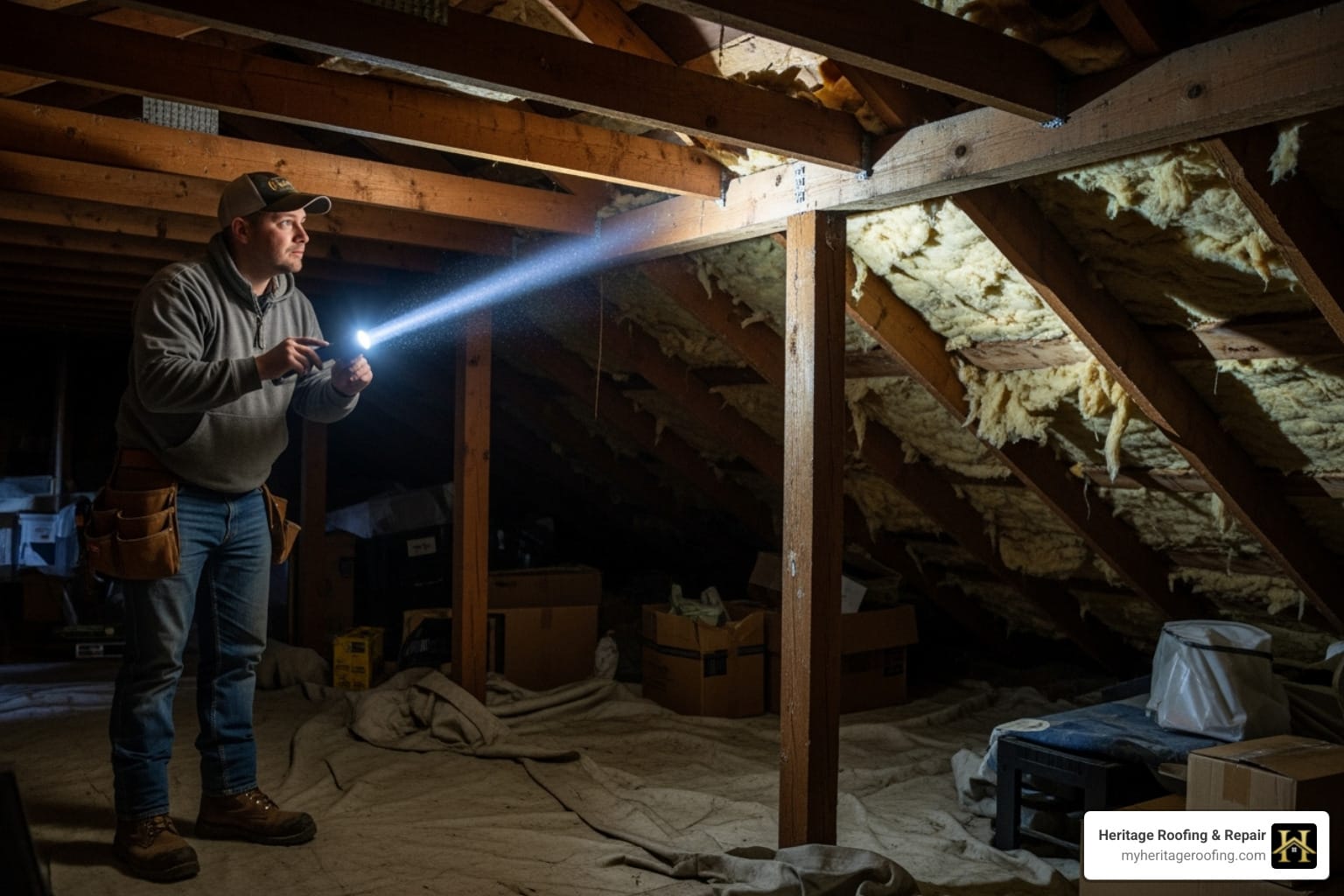
Why Quick Action on Roof Leaks Saves You Thousands
Roof leak detection is the critical first step in protecting your home from water damage that can silently destroy your property and drain your wallet. Whether you’re dealing with visible water stains or suspect hidden moisture, finding and fixing leaks quickly prevents exponential damage to your home’s structure, your family’s health, and your finances. At Heritage Roofing & Repair, a trusted roofing company in Northwest Arkansas, we’ve seen how early intervention turns a potential catastrophe into a manageable repair.
A small leak today becomes a massive problem tomorrow. Studies by the insurance industry show that annual water claims costing more than $500,000 have doubled since 2015, while those over $1 million have tripled. The U.S. Army Corps of Engineering states it is “technically unwise and fiscally irresponsible” to plan roof maintenance without proper leak detection. My family has been providing expert roof leak detection and repair services in Northwest Arkansas for over 50 years, saving countless homeowners from catastrophic damage.
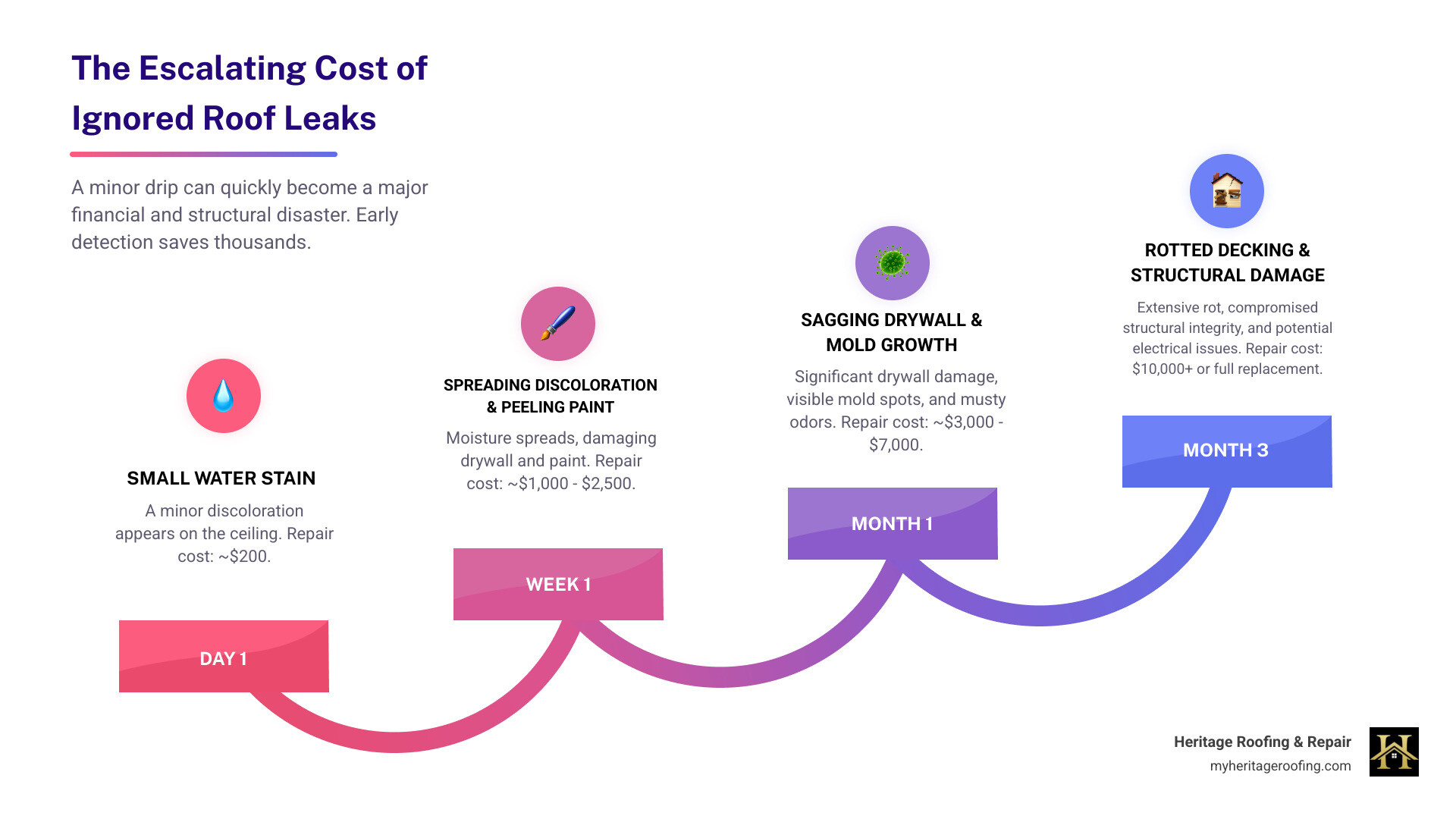
Why Early Detection Is Crucial: The Hidden Costs of a Drip
Ignoring a minor roof leak is a gamble you are statistically likely to lose. Water infiltration is a silent enemy that rots wooden beams, weakens structural supports, and can eventually compromise your foundation. By the time you notice a stain on your ceiling, significant destruction has likely been happening for weeks or months.
This trapped moisture creates a perfect breeding ground for mold and mildew, which release spores that are legitimate health hazards, triggering allergies and worsening respiratory problems. Furthermore, water seeping into walls can reach electrical wiring, creating serious electrical fire risks.
Financially, the consequences are severe. A simple patch might cost a few hundred dollars, but delaying action can lead to thousands in repairs for insulation, drywall, structural beams, and professional mold remediation. Most homeowner’s policies exclude damage from ongoing leaks due to poor maintenance, leaving you to cover the escalating costs. Our guide on Roof Repair Cost details these potential expenses.
Common Causes of Roof Leaks
Understanding where leaks start helps with targeted inspections. Here are the most common culprits:
- Damaged Shingles: Wind, hail, or age can cause shingles to crack, curl, or go missing, exposing the underlayment.
- Cracked Flashing: The metal or rubber seals around chimneys, vents, and skylights can deteriorate, creating an entry point for water.
- Degraded Pipe Boots: The rubber seals around vent pipes crack from UV exposure and temperature changes, allowing water to flow in.
- Clogged Gutters: When gutters overflow, water backs up and seeps under the edge of your roof.
- Ice Dams: In colder climates, melted snow refreezes at the eaves, trapping water that then flows back under shingles.
- Storm Damage: High winds and hail can cause immediate and widespread damage. After a severe storm, a professional inspection is crucial. Learn more in our guide to storm damage roof repair.
The Telltale Signs: How to Spot a Roof Leak in Your Home
Your home provides clear signals of a leak long before water drips into your living room. Catching these signs early requires a regular visual Roof Inspection of your home’s interior and exterior.
Inside your home, look for:
- Water Stains or Discoloration: These often appear on ceilings or walls as yellow, brown, or dark rings that expand over time.
- Peeling or Bubbling Paint: Moisture trapped behind walls causes paint or wallpaper to blister and peel.
- Musty or Moldy Odors: A persistent musty smell, especially in the attic or on upper floors, indicates hidden moisture and potential mold growth.
- Sagging Drywall: Saturated drywall loses its integrity and will sag or feel soft to the touch. This is a sign of significant water accumulation.
- Visible Drips: The most undeniable sign, indicating the leak has progressed to a critical stage.
In your attic, check for:
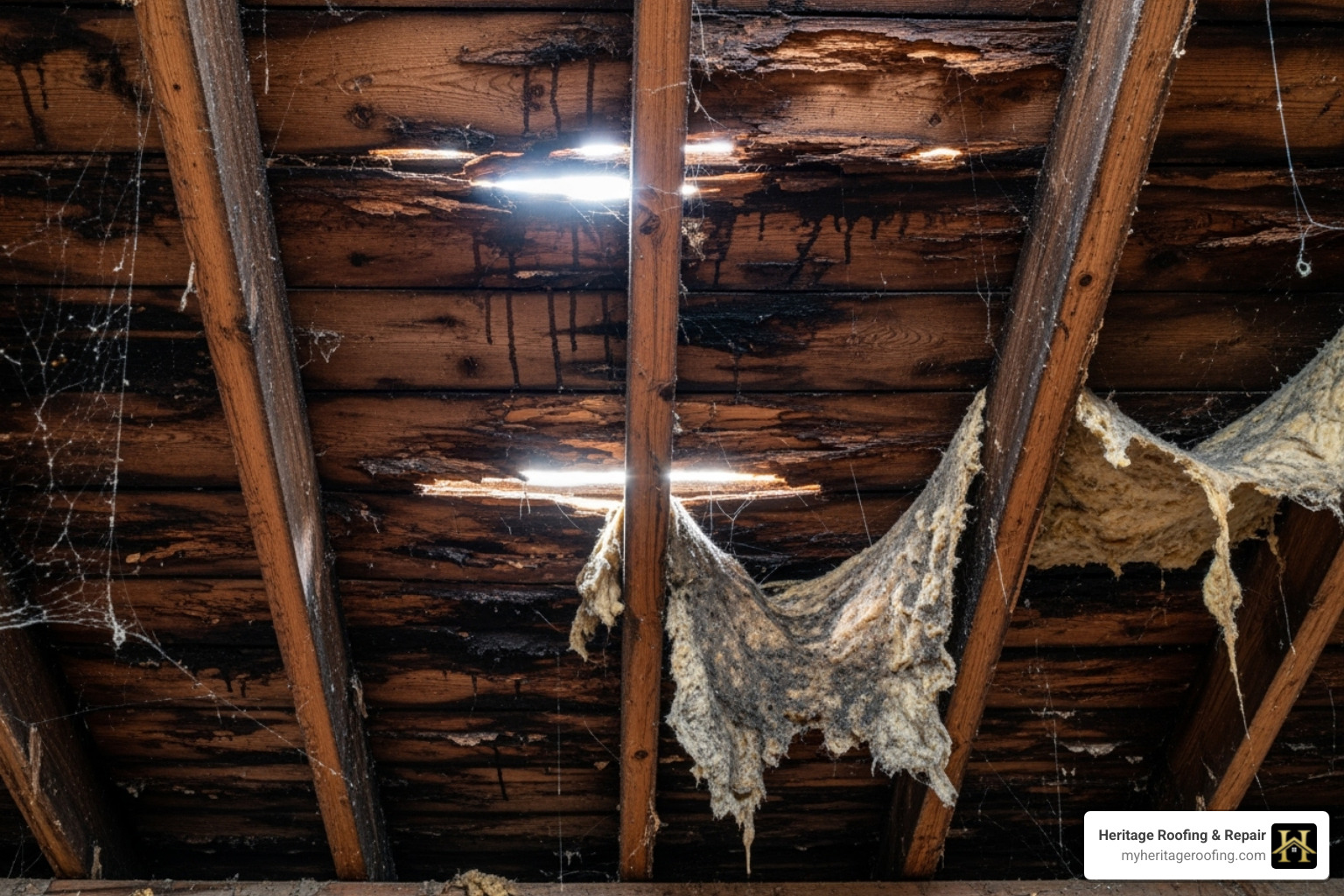
- Dark spots on wood, wet insulation, or streaks of light penetrating through holes are all clear indicators that water is getting in.
From the outside, look for:
- Damaged Shingles: Check for any missing, cracked, curled, or buckled shingles from the ground.
- Granules in Gutters: A large accumulation of sand-like granules from asphalt shingles indicates they are deteriorating and losing their protective layer.
Regularly checking for these signs is your best defense against extensive damage and costly repairs. The earlier you catch a leak, the less damage it can do.
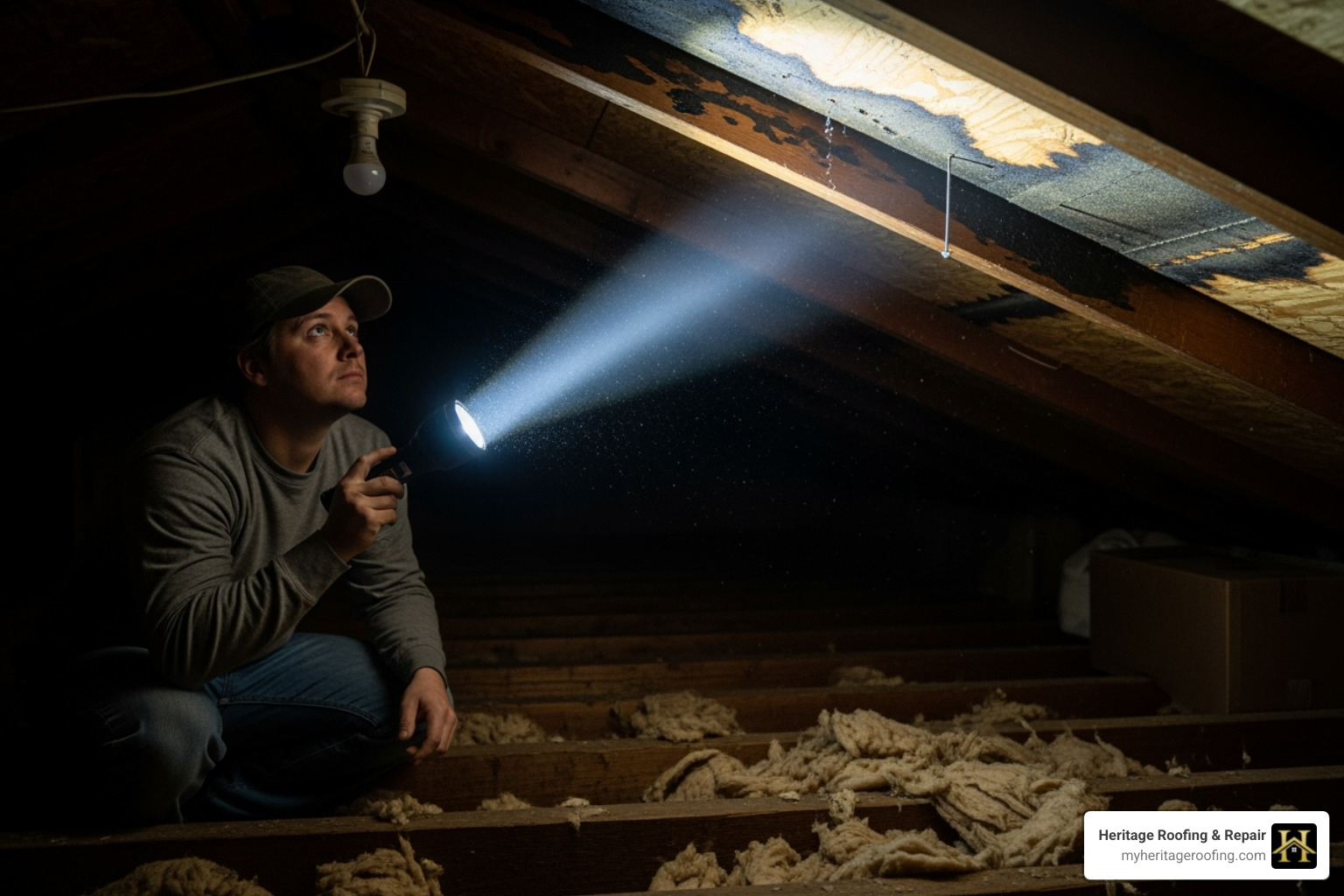
A Pro’s Toolkit: Modern Methods for Advanced Roof Leak Detection
While a visual check is a good start, it often fails to pinpoint a leak’s exact entry point because water can travel along structural supports before becoming visible. Professionals use advanced methods for accurate, non-invasive roof leak detection.
The Starting Point: Visual Inspections
A professional visual inspection is the foundational step. We examine the roof for obvious issues like missing shingles, cracked flashing, or deteriorated sealant. However, many leaks originate from tiny, hidden breaches, making the true source invisible to the naked eye. This is when we employ more advanced techniques.
The Water Test: Simulating Rain to Find the Source
When a leak’s source is elusive, a controlled water test is a reliable method. This involves isolating sections of the roof and using a hose to simulate rainfall in a systematic way, while a second person inside monitors for water entry. This methodical process, demonstrated in videos like this one on how to find a water leak, helps trace the water’s path directly to the source. It is a diagnostic tool for existing roofs, not a verification method for new ones.
Seeing the Unseen: Thermal Imaging
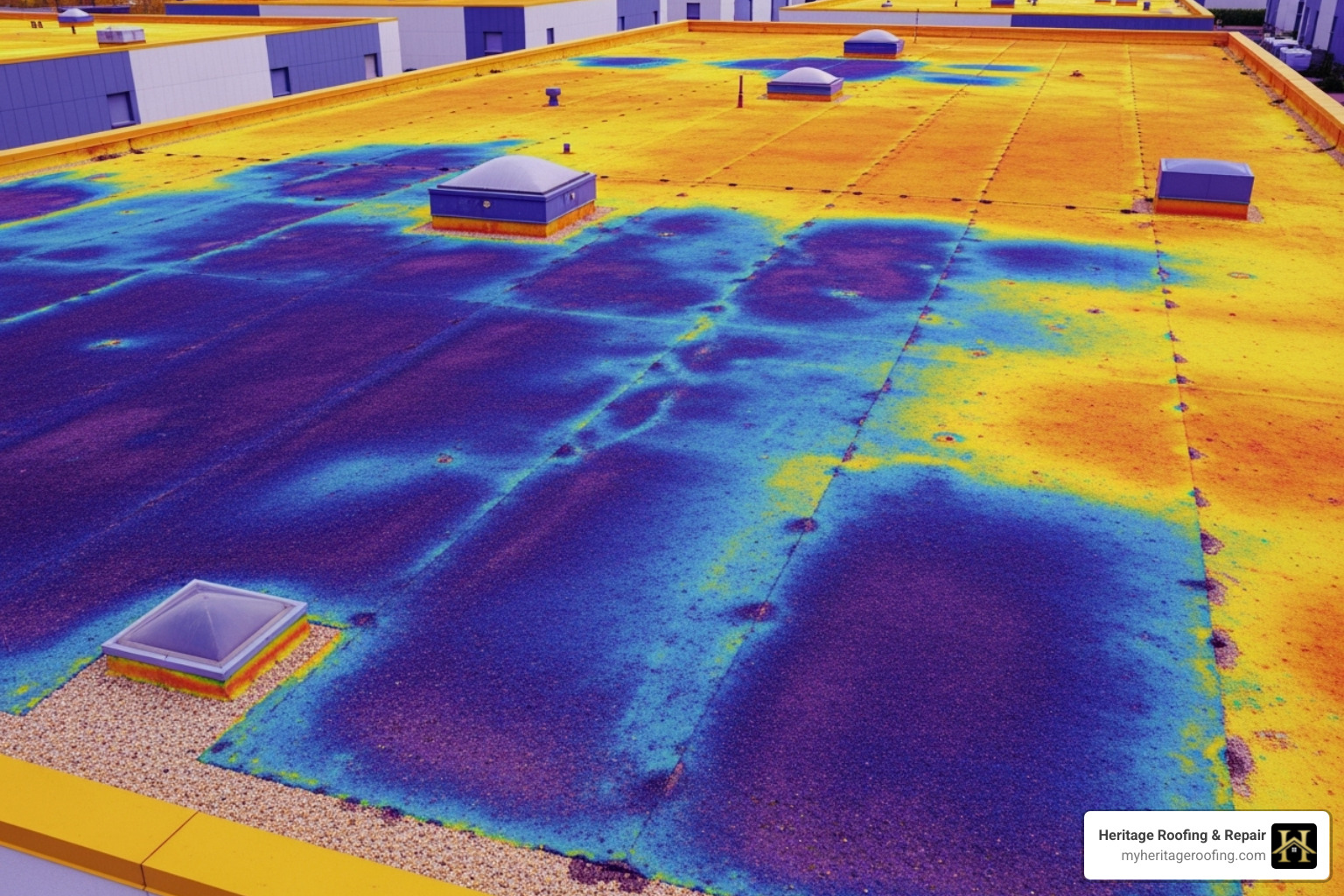
Infrared thermography is a powerful, non-destructive method that detects temperature differences on a roof’s surface. The principle is simple: wet insulation retains heat differently than dry materials. A thermal camera displays these temperature variances as different colors, allowing a professional to “see” trapped moisture within the roof system without any demolition. This non-invasive approach allows for early detection, providing valuable data for effective roof maintenance and preventing extensive damage.
The High-Tech Approach: Electronic Leak Detection (ELD)
Electronic Leak Detection (ELD) is the most sophisticated method for identifying breaches in a roof’s membrane, especially on flat or low-slope roofs. This technology can find pinhole-sized leaks that are impossible to locate visually.
The primary method, Electric Field Vector Mapping (EFVM), involves creating a low-voltage electrical field across a wetted roof surface. Any breach in the waterproof membrane creates a path to the grounded roof deck, which specialized equipment detects with pinpoint accuracy. This technology is crucial for verifying the membrane integrity of new roofs before they are covered by materials like ballast or vegetation, which would make future leak detection far more difficult. The industry’s trust in these methods is underscored by their acceptance in programs like the RoofStar Warranty Program.
One Size Doesn’t Fit All: Leak Detection Challenges for Different Roof Types
The material and design of your roof present unique challenges for roof leak detection. A strategy that works for an asphalt shingle roof may be ineffective for a metal or tile roof. Our expertise spans all roof types, allowing us to tailor our detection methods to your specific needs.
Flat Roofs
Flat roofs are notorious for leaks due to their low slope, which can lead to ponding water. Leaks commonly occur at:
- Ponding Water: Areas where water collects put continuous pressure on the membrane.
- Seam Failure: The seams where membrane sections are joined are common points of failure.
- Membrane Punctures: Debris or foot traffic can puncture the membrane.
- Flashing Issues: Deteriorated flashing around vents, pipes, and parapet walls is a critical vulnerability.
Advanced methods like Electronic Leak Detection (ELD) are particularly effective for these systems.
Asphalt Shingle & Tile Roofs
On sloped roofs, water can travel a long way under shingles or tiles before appearing inside, making the entry point difficult to find. Common issues include:
- Cracked or Missing Shingles/Tiles: Damage from hail, wind, or age creates openings for water.
- Underlayment Damage: A compromised underlayment beneath the tiles or shingles can allow water to reach the roof deck.
- Valley Flashing: Valleys channel large volumes of water, and damaged flashing here is a prime leak spot.
Metal Roofs
While durable, metal roofs have specific weak points, and their smooth surface can cause water to travel in unpredictable ways.
- Failed Fasteners: Gaskets under fasteners can dry out and crack, allowing water penetration.
- Seam Separation: Seams between metal panels can separate due to thermal expansion and contraction.
- Improper Flashing: As with other roof types, poorly installed flashing is a major cause of leaks.
DIY vs. Professional Detection: When to Call for Backup
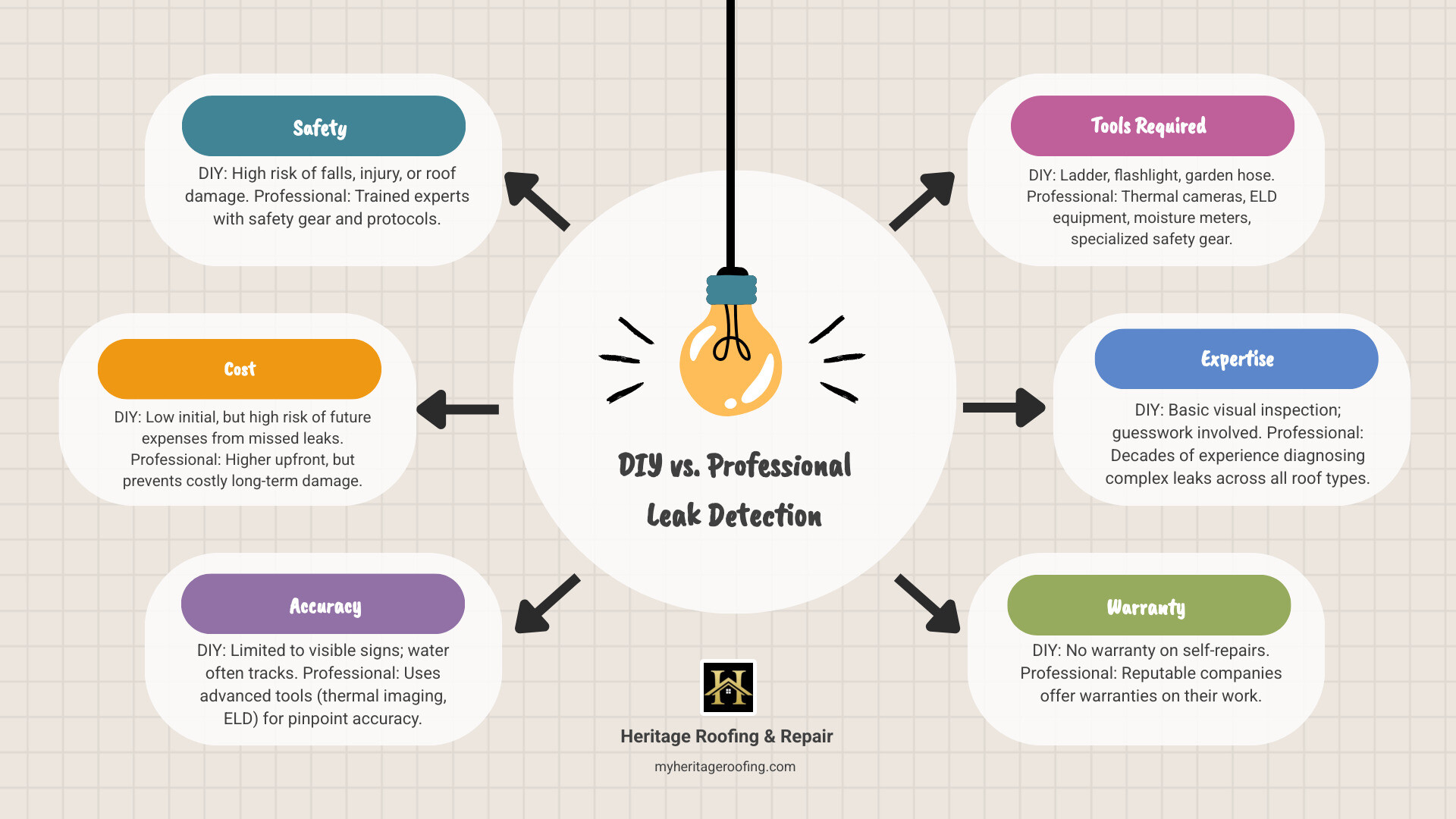
While a homeowner can spot obvious signs, professional roof leak detection offers a level of safety and accuracy that is often necessary to prevent further damage. Choosing between DIY and calling a pro is a balance of safety, thoroughness, and your roof’s long-term health.
Attempting complex inspections or walking on a steep or wet roof without proper safety equipment is extremely dangerous. A misstep can lead to serious injury, and you risk causing more damage by walking on the roof incorrectly. Most homeowners also lack the training and tools to diagnose hidden leaks, as water rarely travels in a straight line from the entry point.
Professionals use advanced tools like thermal imaging cameras, moisture meters, and Electronic Leak Detection (ELD) equipment to pinpoint breaches with surgical precision. When you hire an expert for roof repair, you are investing in their experience and ensuring the problem is fixed correctly the first time. Reputable professionals also offer warranties on their work, giving you peace of mind.
Here’s a quick comparison:
| Feature | DIY Leak Detection | Professional Leak Detection |
|---|---|---|
| Safety | High risk of falls and injury | Trained professionals with safety gear |
| Cost | Low initial cost, high risk of future expenses | Higher upfront cost, prevents costly long-term damage |
| Accuracy | Limited to visible signs; source is often misdiagnosed | Advanced tools for pinpoint accuracy |
| Expertise | Basic visual inspection; guesswork involved | Decades of experience diagnosing complex leaks |
| Warranty | None | Warranties offered on work |
The bottom line: if you’re dealing with anything more than a simple visual check from the ground, or if you’re uncomfortable with heights, it’s time to call the experts. For reliable detection and repair in Berryville, AR, trust an expert.
Heritage Roofing & Repair
3458 Arkansas State Hwy 221, Berryville, AR 72616
(870) 654-1164
Frequently Asked Questions about Roof Leak Detection
How much does professional roof leak detection cost?
The cost varies based on the roof’s size, complexity, and the method required. A simple visual inspection may be part of a free estimate, while advanced services like thermal imaging or ELD can range from a few hundred to over a thousand dollars. This investment is minimal compared to the potential cost of unaddressed water damage.
Can a small roof leak wait to be repaired?
No. A small leak is an emergency in slow motion. Water will continue to damage insulation, drywall, and structural components, leading to mold growth and significantly higher repair costs. Address any leak immediately.
How long does it take to find a roof leak?
The time can range from under an hour for an obvious leak to several hours for a complex issue requiring multiple detection methods. A thorough water test or ELD scan will take longer than spotting a missing shingle. The goal is accuracy, not speed, to ensure a lasting repair.
Conclusion: Protect Your Investment with Proactive Maintenance
Your roof is your home’s first line of defense, and protecting it requires proactive care. Understanding the signs of a leak and the methods used for roof leak detection empowers you to act quickly and prevent minor issues from becoming major disasters. A small investment in preventative maintenance today can save you from catastrophic expenses tomorrow.
We’ve walked you through everything from spotting early warning signs to understanding the advanced technology professionals use to pinpoint hidden leaks. Your roof isn’t just shingles and nails; it’s the shield that keeps your family safe and your home’s value intact. Treating it with care means scheduling regular inspections and addressing problems immediately.
With over 50 years of trusted experience, the team at Heritage Roofing & Repair provides dependable solutions for homeowners across Northwest Arkansas. We’ve seen how early detection saves thousands of dollars and countless headaches. If you suspect a leak or want to schedule a preventative inspection, don’t wait for the next storm. We’re here to protect what matters most—your home and your peace of mind.