Why Filing a Homeowners Insurance Claim for Roof Damage Requires a Strategic Approach
Filing a homeowners insurance claim for roof damage is a process that can either secure the funds you need for repairs or leave you with unexpected out-of-pocket costs. The outcome often depends on understanding your policy, documenting damage correctly, and navigating the claims process with precision. With the right knowledge and a trusted partner from Heritage Roofing & Repair, you can turn a stressful situation into a smooth restoration.
What’s at stake? The average insurance payout for wind and hail damage is around $13,000, but homeowners with Actual Cash Value policies can lose thousands to depreciation. Failing to document properly or missing filing deadlines can lead to claim denial.
I’m Rex Wisdom, owner of Heritage Roofing & Repair. For over five decades, my family has guided hundreds of Northwest Arkansas homeowners through the process of filing a homeowners insurance claim for roof damage. In this guide, I’ll share the strategies that have helped our customers secure fair settlements and quality repairs.
Before You File: Understanding Your Homeowners Insurance Policy
Before calling your insurer about roof damage, you must understand your policy. This is the most important step in the claims process, as it can save you from major headaches and unexpected costs. The average payout for wind and hail damage is around $13,000, but this figure is meaningless without knowing your specific coverage. Your neighbor might get a full roof replacement, while you’re left covering half the cost for the same storm damage—all because they understood their policy.
What Roof Damage Is (and Isn’t) Covered?
Most standard homeowners policies cover damage from sudden, accidental events, called “perils.” This is damage that happens quickly, not gradually over time. Understanding this is crucial when filing a homeowners insurance claim for roof damage.
Typically Covered Perils:
- Wind Damage: High winds lifting, tearing, or loosening shingles.
- Hail Damage: Granule loss, indentations, or cracks that reduce your roof’s lifespan, even if not immediately visible.
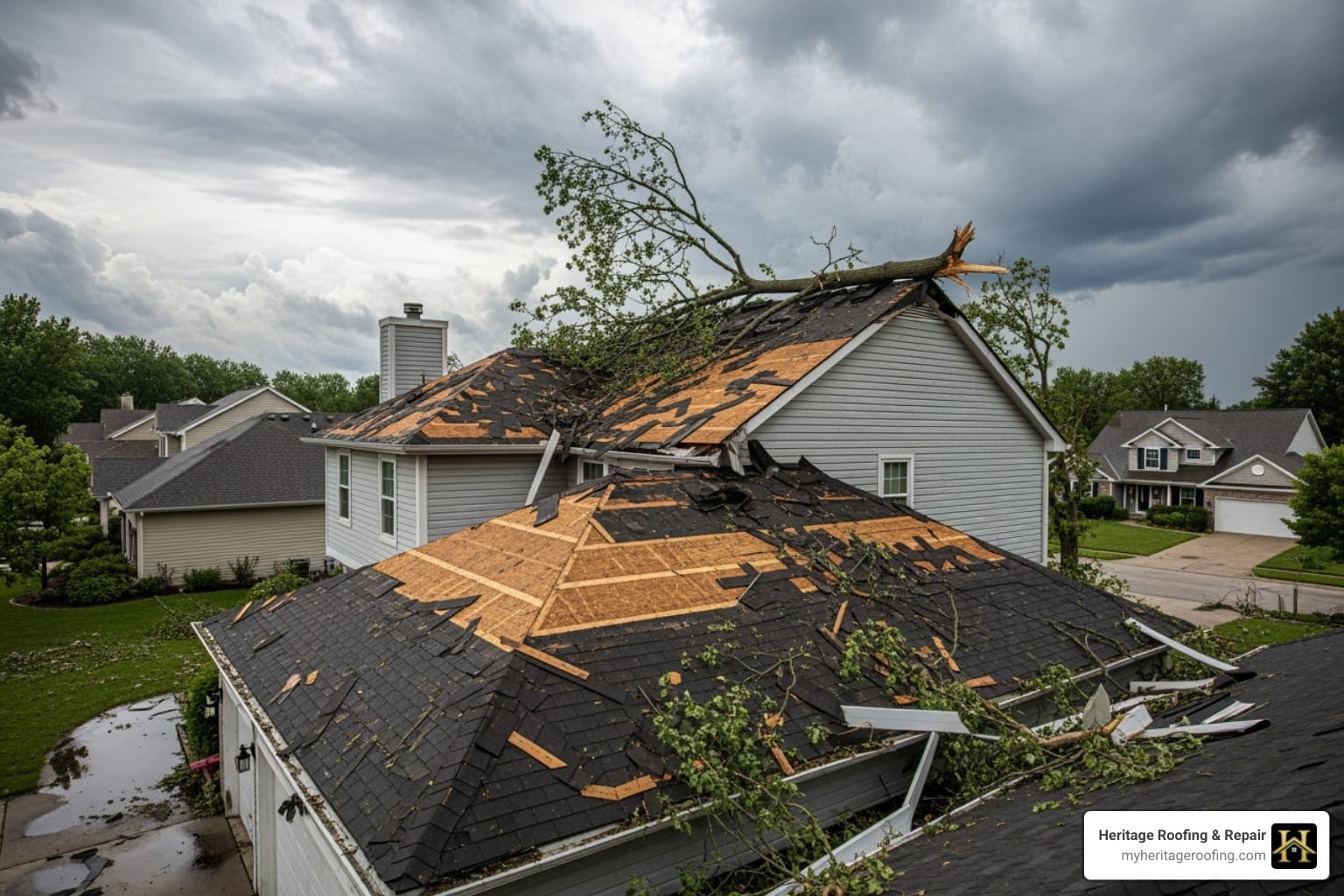
- Falling Objects: Damage from fallen trees, branches, or other storm debris.
- Fire Damage: Damage from fires starting inside or outside the home.
- Weight of Snow and Ice: Structural damage or ice dams forcing water under shingles.
- Vandalism: Intentional damage to your roof by others.
Common Exclusions (Not Covered):
- Normal Wear and Tear: Your policy is not a maintenance plan. An old roof that has reached the end of its lifespan is your responsibility.
- Neglect or Lack of Maintenance: Failure to clean gutters, trim branches, or replace deteriorating shingles can lead to claim denial.
- Poor Workmanship: Faulty installation is an issue to take up with your contractor, not your insurer.
- Flood Damage: Requires a separate flood insurance policy.
- Earthquake Damage: Requires a separate earthquake policy.
- Cosmetic Damage: Some policies exclude minor dents or marks that don’t affect the roof’s function, especially in hail-prone areas.
ACV vs. RCV: A Critical Difference That Impacts Your Payout
This is the single biggest factor determining how much money you receive. Many homeowners assume they’re covered for a full replacement, only to find an Actual Cash Value policy leaves them thousands short.
- Actual Cash Value (ACV): Pays the depreciated value of your roof. If a 25-year roof is 10 years old, the insurer subtracts 40% for depreciation. On a $15,000 replacement, you might only get $9,000 (minus your deductible).
- Replacement Cost Value (RCV): Covers the full cost to replace your roof with new materials of similar quality at current prices, without subtracting depreciation. You are made whole. Payment is typically in two stages: an initial ACV payment, followed by the remaining funds (depreciation holdback) after repairs are complete and invoiced.
Check your policy declarations page now to see which type you have. Learn more about policy types.
Here’s how these policies affect a $15,000 roof replacement on a 10-year-old roof:
| Factor | Replacement Cost Value (RCV) Policy | Actual Cash Value (ACV) Policy |
|---|---|---|
| Roof Replacement Cost | $15,000 | $15,000 |
| Deductible | $1,000 | $1,000 |
| Depreciation (10-year-old roof) | $5,000 (withheld, then paid) | $5,000 |
| Initial Payout | $9,000 | $9,000 |
| Final Payout (after repairs) | $14,000 (full RCV minus deductible) | $9,000 |
| Your Out-of-Pocket Cost | $1,000 (deductible) | $6,000 (deductible + depreciation) |
That $5,000 difference is money you’ll never get back with an ACV policy.
Decoding Your Deductible and Policy Limits
Your deductible is what you pay out-of-pocket before insurance kicks in. There are two types:
- Fixed Deductible: A set dollar amount (e.g., $1,000). For a $10,000 repair, you pay $1,000, and insurance covers $9,000.
- Percentage Deductible: Calculated as a percentage of your home’s total insured value, not the repair cost. A percentage deductible of 1% on a $300,000 home means you pay the first $3,000 of any claim. This often applies specifically to wind and hail damage and can be a costly surprise.
Policy limits are the maximum your insurer will pay for a claim. Some policies have a “stated limit” for roof replacement that caps the payout regardless of actual costs. Also, review any endorsements—modifications that can increase or decrease coverage. Ensure you haven’t inadvertently given up crucial protection to lower your premium.
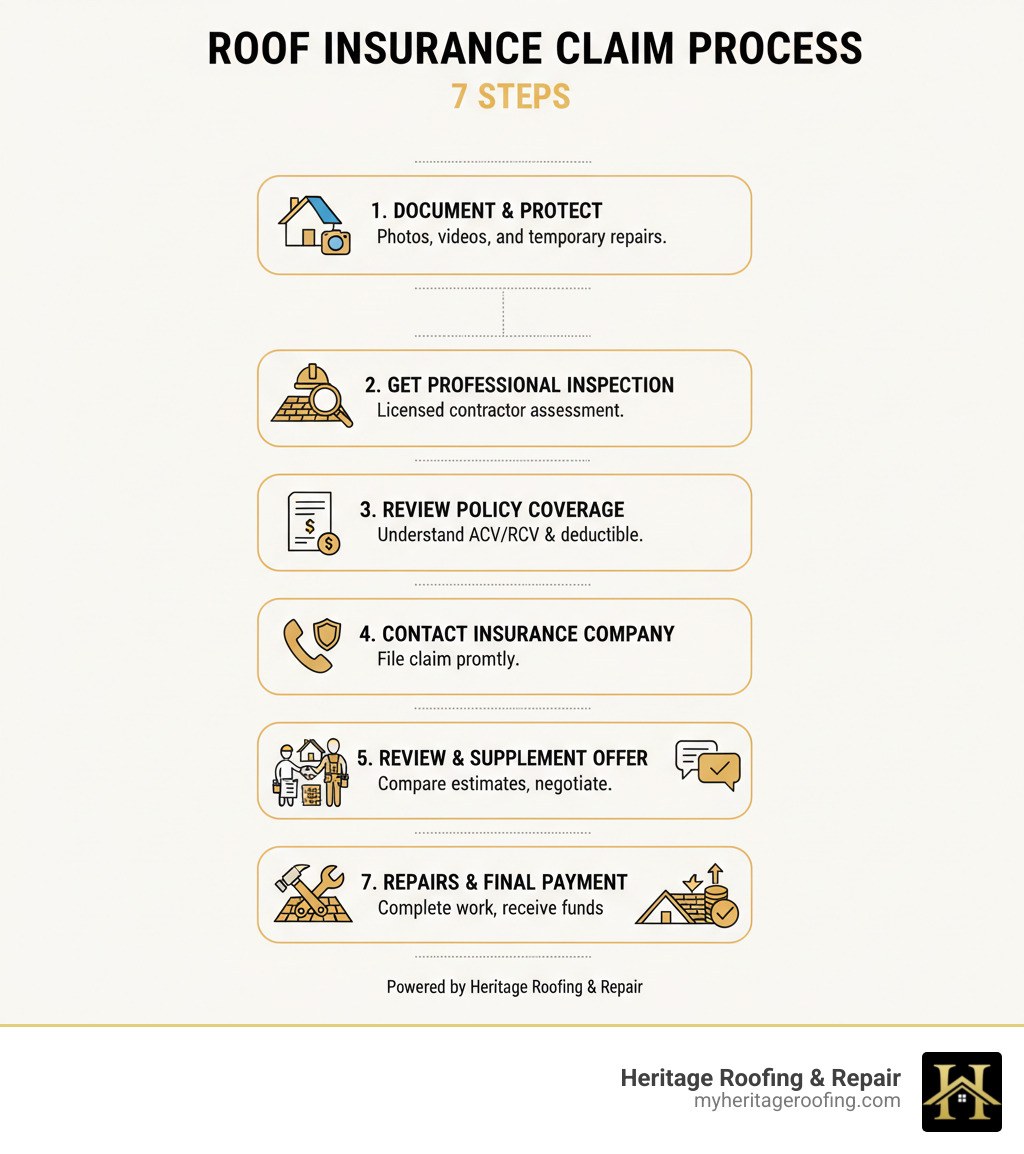
The 7-Step Guide to Filing a Homeowners Insurance Claim for Roof Damage
Following a structured process ensures your claim is handled efficiently and fairly. This guide is your roadmap from the moment you spot damage to the final payment.
Step 1: Prioritize Safety and Prevent Further Damage
First, ensure everyone is safe. If you see downed power lines or serious structural issues like a sagging roof, call emergency services. Once safe, your next job is to prevent further damage. A small leak can quickly lead to ruined insulation or mold. Place buckets under active leaks and consider having your roof tarped for larger issues.
Most policies cover the cost of reasonable temporary repairs, so keep all receipts for materials or professional help. Learn more in our Emergency Roof Repair Complete Guide. Document these temporary fixes with photos to show your insurer you took responsible steps to mitigate the loss.
Step 2: A guide to documenting when filing a homeowners insurance claim for roof damage
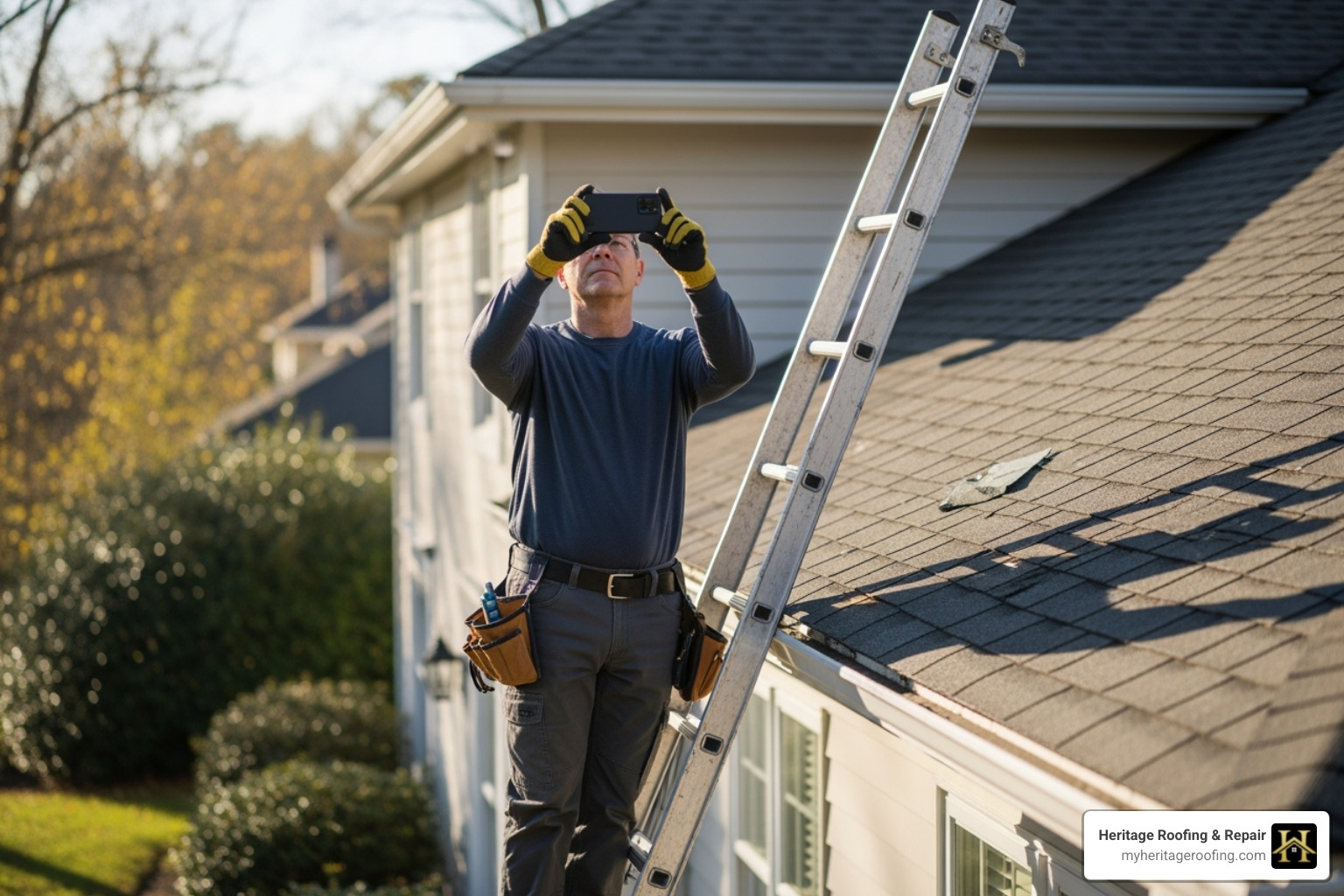
Thorough documentation is the foundation of a successful claim. Before calling anyone, use your smartphone to take dozens of photos from every safe angle. Get close-ups of damaged shingles, hail dents, and torn flashing, then take wide-angle shots to show the overall context. Ensure your photos are time-stamped to tie the damage to a specific storm.
Take videos as well, narrating what you see. Keep a written log noting the location and type of damage. If storm-related, gather weather reports from the National Weather Service to corroborate your claim that the damage occurred during a specific covered event.
Step 3: Get a Professional Roof Inspection
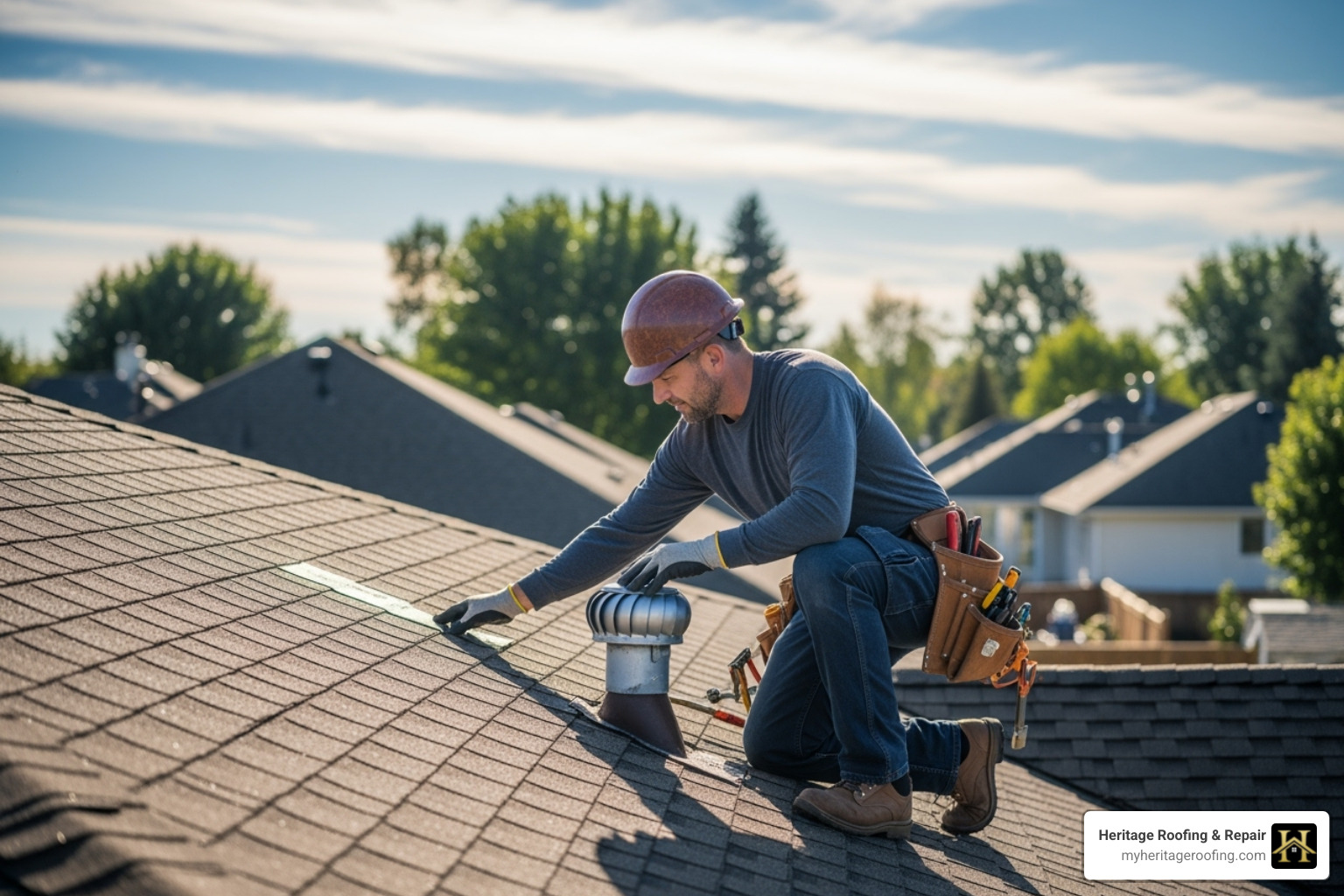
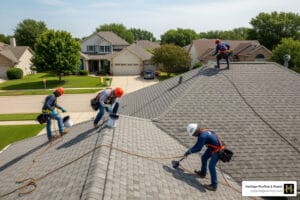
Before contacting your insurer, schedule a professional inspection with a licensed, local roofing contractor. A trained roofer can identify damage invisible from the ground, such as granule loss from hail or loosened seal strips from wind. These hidden issues are what your claim should cover.
Choose a reputable contractor experienced in insurance claims. They know what adjusters look for and will provide a comprehensive damage report with photos and a detailed repair estimate. This professional documentation serves as your baseline for negotiations and shows your insurer you are serious and organized.
Step 4: Contact Your Insurance Company to Initiate the Claim
Now you can officially start the process. Most policies require you to report damage within 30 to 60 days, so don’t wait. Have your policy number and the date of loss ready. You can often file online, through a mobile app, or by phone. For example, State Farm allows claims via their app, website, agent, or by calling 800-SF-CLAIM (800-732-5246).
During the call, you’ll be assigned a claim number—write it down. You’ll need it for all future communication. Be honest in your answers, but don’t guess at technical details. It’s fine to say, “I’m not sure, but my contractor documented it in their report.”
Step 5: Meet the Insurance Adjuster (and Your Contractor)
Within a week or two, an adjuster will visit to assess the damage. This is a critical meeting, and you should have your roofing contractor present. Your contractor works for you and can advocate on your behalf, ensuring all damage is identified.
Schedule the inspection when both you and your contractor can attend. Your contractor speaks the technical language of adjusters and can discuss the necessary scope of work. This collaborative approach prevents misunderstandings and ensures nothing is overlooked. The adjuster will take their own photos and notes to determine what repairs are covered under your policy.
Step 6: Review the Adjuster’s Report and Get Repair Estimates
After the inspection, the adjuster will provide a report and an initial settlement offer. Review this document carefully with your contractor. Insurers often use software like Xactimate to generate estimates, but these can sometimes undervalue repair costs.
It’s common for the adjuster’s initial estimate to be lower than your contractor’s. This often means line items were missed or pricing was outdated. Your contractor can then file a “supplement”—a formal request for additional funds to cover these discrepancies. This is a normal part of the claims process, so be prepared to negotiate to get a fair settlement.
Step 7: Complete Repairs and Finalize the Claim
Once you and your insurer agree on the settlement, it’s time to fix your roof. For RCV policies, you’ll receive payment in two stages.
The first check is for the Actual Cash Value (ACV)—the replacement cost minus depreciation and your deductible. This allows work to begin. Your contractor will then perform the Storm Damage Roof Repair or replacement.
Once work is complete, your contractor provides a final invoice. Submit this to your insurer to trigger the release of the second payment: the depreciation holdback. This brings your total payout to the full replacement cost, minus your deductible. Keep copies of all paperwork, including estimates, invoices, and checks, for your records.
Navigating the Aftermath: Common Challenges and How to Overcome Them
Claim denials, lowball offers, and “storm chaser” contractors can derail your claim. Being prepared for these common problems is the best way to ensure a smooth process and a fair outcome.
What to Do If Your Roof Damage Claim is Denied or Undervalued

A denial is not the final word. You have the right to appeal. Here’s what to do:
- Understand the Denial: Your insurer must provide a written explanation. Review it carefully against your policy. Common reasons include pre-existing damage, wear and tear, or insufficient documentation.
- Gather More Evidence: Provide more compelling photos or a more detailed contractor report to counter the denial.
- Request a Second Review: Ask your insurance company for a review by a different adjuster.
- File a Formal Appeal: If the second review fails, send a formal appeal letter via certified mail, citing specific policy language and presenting all your evidence.
- Consider a Public Adjuster: A public adjuster works for you to assess damage and negotiate with your insurer. They typically charge a percentage of the settlement and can be valuable for complex claims.
- Consult an Attorney: As a last resort for bad faith claims, a property damage attorney can help you understand your legal rights.
The Dangers of “Storm Chasers” and Unusually Low Bids
After a major storm, be wary of out-of-state contractors, or “storm chasers,” who go door-to-door. They often perform low-quality work and disappear, leaving you with no warranty.
- “Waiving” Your Deductible is Illegal: If a contractor offers to cover your deductible, it is a form of insurance fraud. The deductible is your responsibility. Is it OK for a contractor to waive my deductible? No, it is not.
- Low Bids Often Mean Low Quality: A bid substantially lower than others may indicate inferior materials, cut corners, or inadequate insurance, leading to future roof failure.
- Avoid High-Pressure Tactics: Legitimate contractors do not pressure you to sign a contract on the spot. Take your time to vet them properly.
Why Choosing a Local, Experienced Contractor is Your Best Defense
A local contractor has a vested interest in maintaining a good reputation in the community. They understand local building codes, have established relationships with suppliers, and are accountable for their work.
For trusted, local expertise, consider a contractor with deep roots in the community. At Heritage Roofing & Repair, we have been serving Berryville, AR, and surrounding areas for over 50 years, building trust one roof at a time. An experienced local contractor knows how to work with insurance companies, steer the claims process, and advocate for a fair settlement. Always verify that any contractor you consider is licensed, bonded, and insured.
Heritage Roofing & Repair
3458 Arkansas State Hwy 221, Berryville, AR 72616
(870) 654-1164
Frequently Asked Questions About Roof Damage Claims
How long does the roof damage insurance claim process typically take?
The process of filing a homeowners insurance claim for roof damage can take from a few weeks to several months. After you file, expect an adjuster inspection within 1 to 2 weeks. An approval decision usually follows in 7 to 10 days. The first payment typically arrives within 30 to 60 days of approval. However, timelines can extend significantly after a widespread disaster due to high claim volume. Providing complete documentation promptly is the best way to speed up the process.
Will filing a claim for roof damage raise my insurance premiums?
Filing a single claim for weather-related damage—an “act of God”—is less likely to raise your individual premium than a claim for negligence. However, if a major storm causes widespread damage in your area, insurers may raise rates for the entire region to offset their losses, regardless of whether you filed a claim.
Insurers review claims history for 3 to 7 years. One claim for unavoidable damage is unlikely to have a major impact. However, filing multiple claims in a short period could lead to higher rates or non-renewal. If the damage is minor and only slightly above your deductible, consider paying out of pocket to keep your claims history clean. For major damage, filing a claim is the right decision.
What is ‘Ordinance and Law Coverage’ and why is it important?
Ordinance and Law Coverage is a crucial policy add-on that pays the extra costs to bring your roof up to current building codes during a repair. Building codes are constantly updated for safety. If your older roof is damaged, local ordinances may require upgrades like more robust decking or different ventilation systems that your original roof didn’t have.
Without this coverage, your standard policy may only pay to replace your roof exactly as it was, leaving you to cover thousands in mandatory upgrades out of pocket. This coverage is especially important for older homes. Check your policy for this endorsement; the small additional premium is almost always worth the protection it provides.
At Heritage Roofing & Repair, we’ve seen countless situations where Ordinance and Law Coverage saved homeowners from financial hardship. It’s protection you hope to never need but will be grateful to have if you do.
Your Partner in Storm Recovery
Successfully filing a homeowners insurance claim for roof damage requires diligence, documentation, and a deep understanding of your policy. By following the steps in this guide, you can protect your investment and ensure your home is restored correctly without facing unexpected costs.
The most important decision in this process is choosing a reputable, local roofing partner to advocate for you. A trusted contractor is your best defense against common pitfalls and is essential for a smooth claims process.
With over 50 years of experience helping Arkansas homeowners, Heritage Roofing & Repair has the expertise to make your recovery seamless. Our team speaks the “insurance language,” allowing us to spot overlooked damage, identify low estimates, and negotiate effectively on your behalf. We handle the technical details, paperwork, and negotiations, so you can focus on getting your life back to normal.
Don’t face the insurance claims process alone. Whether you’re dealing with wind, hail, or other covered damage, an experienced local partner makes all the difference. Reach out today for a free inspection and let us guide you through every step of your insurance claim. Your roof protects everything you hold dear—let us protect your investment.