Hail Roof Damage: Spot It Early to Protect Your Home
Hail damage roof impacts cause billions in damage across the U.S. annually. The real challenge is that most homeowners don’t realize their roof is compromised until leaks appear. By then, minor surface damage has escalated into costly water intrusion and structural issues. Even pea-sized hail can fracture your roof’s underlying structure, leading to problems months later. Understanding the warning signs is the first step in protecting your home, and that often begins with an assessment from a trusted local roofing expert.
NOAA’s Storm Events Database recorded more than 4,600 U.S. hail reports in 2023, and severe convective storms drove over $60 billion in insured losses—hail is a leading driver of those losses. Definitive, early documentation is the difference between a minor repair and a full replacement. NOAA Storm Events | Insurance Information Institute
The real danger lies in what you can’t see—fractured fiberglass mats and weakened self-seal strips that won’t show symptoms until months later. I’m Rex Wisdom, owner of Heritage Roofing & Repair. My family has served Berryville and Northwest Arkansas for over 50 years, assessing and repairing thousands of hail-damaged roofs. We help homeowners steer everything from initial inspections to complex insurance claims, ensuring no hidden damage goes unaddressed.
Find more about Hail damage roof:
- filing a homeowners insurance claim for roof damage
- how to file roof replacement insurance claim with adjuster
- should i file an insurance claim for my roof
How to Identify Hail Damage on Different Roofing Materials
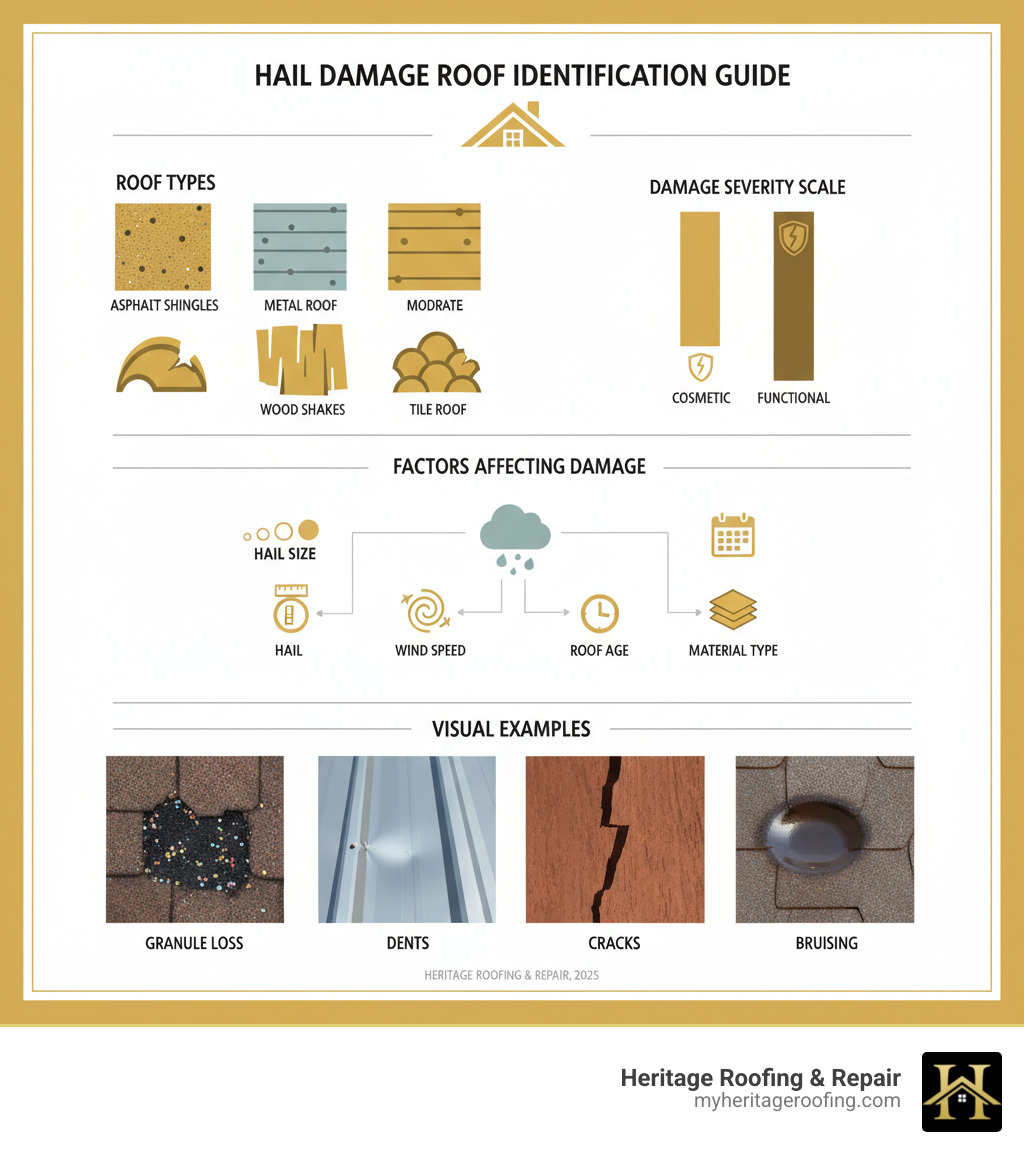
The way hail damage roof impacts appear depends entirely on your roofing material. A dent that’s obvious on metal might be nearly invisible on asphalt. Understanding these differences is key to catching damage before it becomes a major problem.
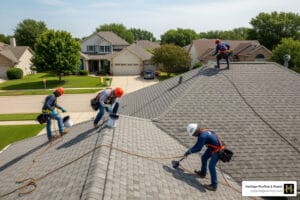
Before inspecting, prioritize your safety: stay off your roof. A slippery or damaged roof is dangerous. Use binoculars from the ground, or better yet, call us at Heritage Roofing & Repair for a professional roof inspection. We’ve been doing this safely for over 50 years and know exactly what to look for.
Signs of Hail Damage on Asphalt Shingles
Asphalt shingles are the most common roofing material, and hail damage to them can be subtle.
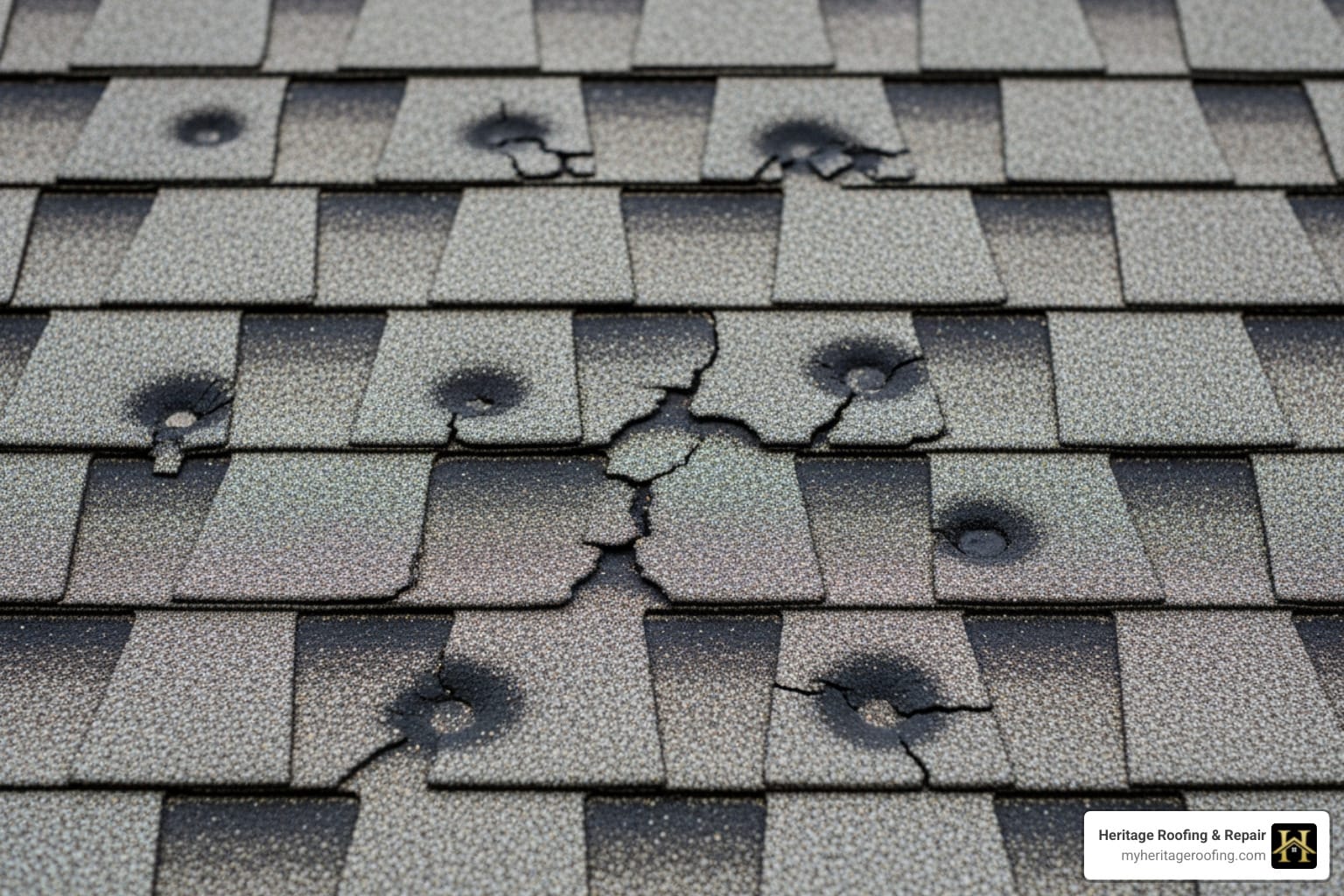
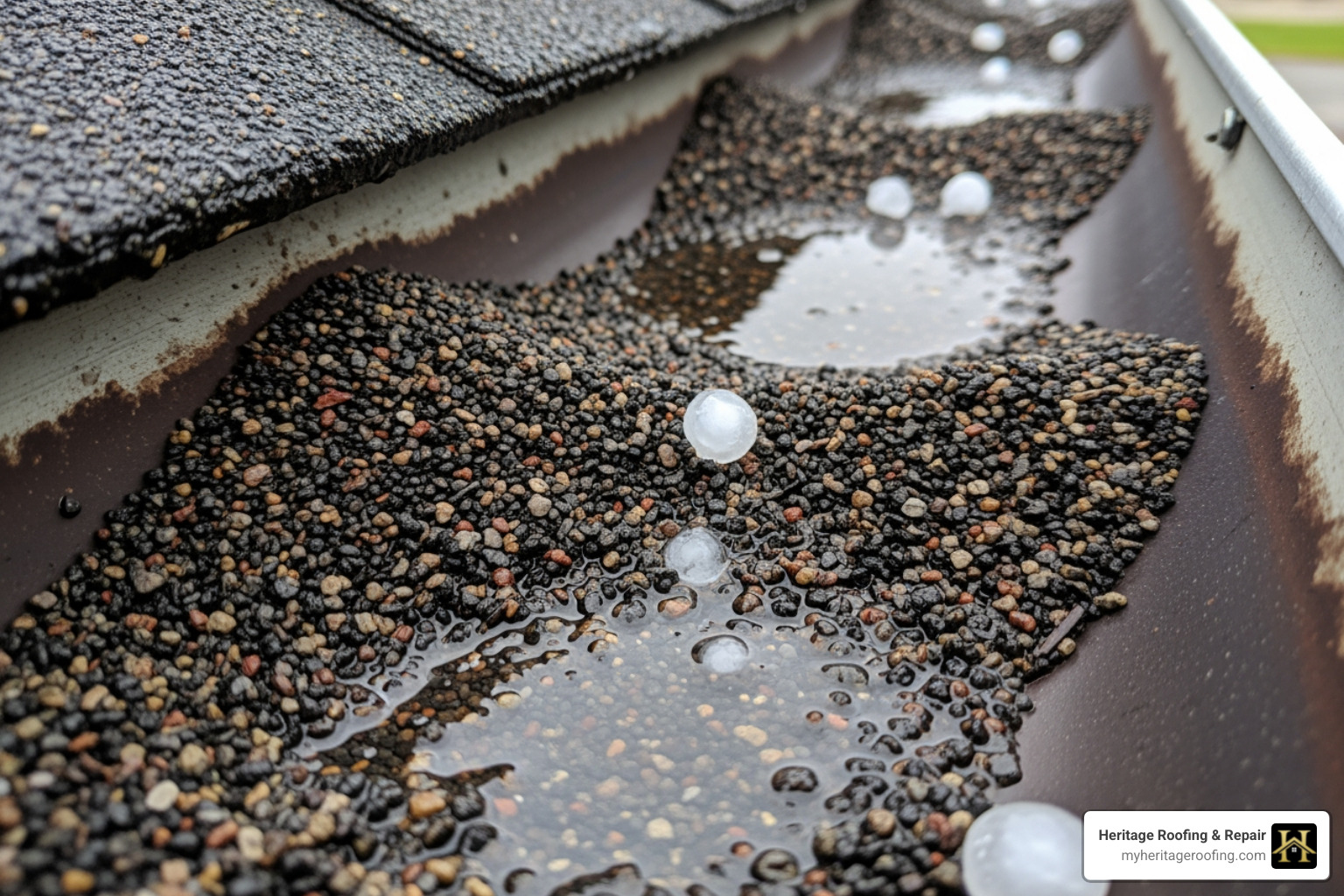
- Granule Loss: Hail knocks off the protective granules that shield shingles from UV rays. Check your gutters for accumulations of what looks like coarse, dark sand. On the roof, this appears as dark spots where the black asphalt mat is exposed.
- Bruising: Hail impacts create soft, spongy spots on the shingle, similar to a bruise on fruit. These areas may look shiny or wet and indicate the underlying fiberglass mat is compromised, even if there’s no tear.
- Cracks and Exposed Felt: Larger hailstones can leave circular cracks or crescent-shaped tears. When enough granules are lost, the underlying felt becomes exposed, drastically accelerating the shingle’s aging process.
Hail damage is distinguished by its random pattern, unlike the uniform appearance of normal wear and tear like blistering or flaking.
What Hail Damage Looks Like on Metal Roofs
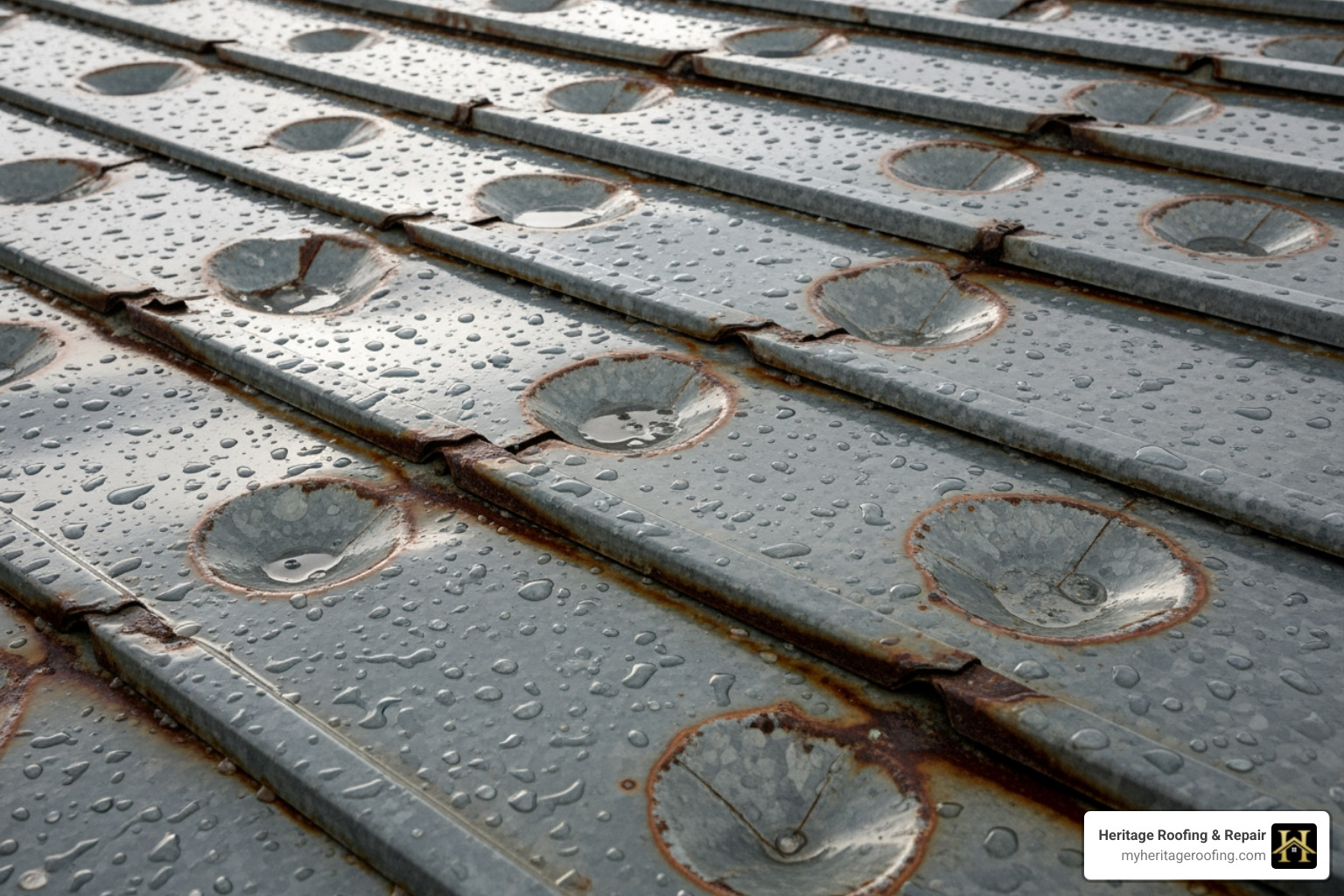
Metal roofing is tough but not invincible. The most common signs of hail damage are dents and dings, which are usually cosmetic but can affect resale value. More serious damage includes scratches and finish removal, where the protective coating is chipped away, exposing the metal to corrosion. While rare, punctures from very large or sharp hailstones can create immediate leak points. Always check softer metal components like gutters and vents, as they often show clear evidence of hail impact.
Identifying Damage on Wood Shakes and Shingles
Instead of denting, wood shakes and shingles tend to split and fracture under hail impact. The telltale sign is a fresh split with sharp edges that reveals lighter, unweathered wood, often appearing brown or orange against the grayed exterior. This is distinct from natural weathering, which causes cracks with rounded, eroded edges. You may also see impact marks or dents where the wood absorbed the blow without fully splitting. More info on identifying damage on wood can help you understand the technical details.
Damage Indicators for Clay, Slate, and Concrete Tiles
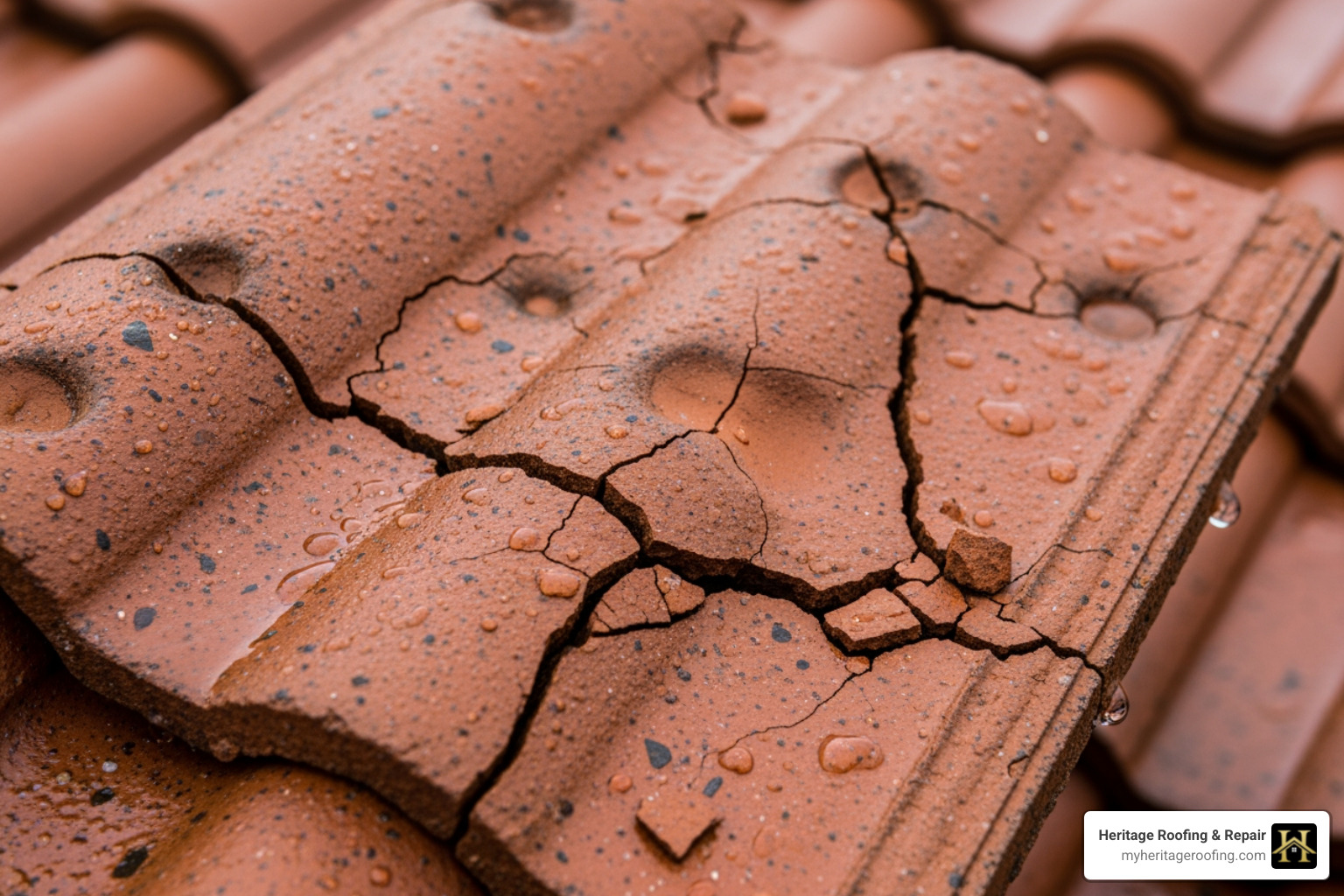
Tile roofs are durable but brittle. Hail damage often appears as chipped corners and edges. More severe impacts can cause hairline cracks across the tile face or leave shattered tiles broken into multiple pieces. This damage creates obvious openings for water intrusion. Sometimes, the impact may only dislodge or loosen a tile, compromising its seal and making it vulnerable to wind. Any sign of exposed underlayment is a clear indicator that your roof’s water-shedding ability is compromised.
Functional vs. Cosmetic Damage: What Insurance Actually Covers
After a storm, you’ll hear roofers and adjusters discuss “functional” versus “cosmetic” damage. This distinction is the single most important factor in determining whether your insurance company will cover repairs. At Heritage Roofing & Repair, we’ve spent decades helping Northwest Arkansas homeowners steer these conversations, and we know what makes the difference.
Defining Functional Hail Damage to Your Roof
Functional damage is any impairment that prevents your roof from protecting your home as intended. Insurance policies are designed to cover this type of real, measurable loss.
An insurance carrier defines functional damage as any impact that:
- Reduces the roof’s ability to shed water. This includes punctures, cracks, or displaced shingles that create a pathway for water, even if a leak is not yet active.
- Shortens the roof’s expected service life. Widespread granule loss that exposes asphalt to UV degradation is a prime example. A shingle designed to last 25 years may have its life cut in half, which is a quantifiable loss.
Fractures in the shingle mat are a critical form of functional damage often invisible from the ground. The shingle’s structural integrity is compromised, making it vulnerable to tearing and failure. This hidden damage is precisely why a professional inspection is essential to identify the true extent of a hail damage roof.
Understanding Cosmetic Damage and Your Policy
Cosmetic damage affects your roof’s appearance without immediately compromising its function. Think of it like a dent in a car door—it’s unsightly, but the car still drives. Common examples include:
- Dents on metal vents, flashing, or gutters that are still secure and working properly.
- Minor, localized granule loss that does not expose the underlying shingle mat.
- Slight discoloration from hail impacts.
Here’s the challenge: many standard insurance policies do not cover cosmetic damage, or they require a special endorsement (add-on) for such coverage. The line between cosmetic and functional is not always clear. A small area of granule loss an adjuster calls “cosmetic” today could become a leak point within a year. This is where an experienced roofer becomes your advocate, documenting all damage to ensure a fair assessment that protects your long-term interests. Learn the technical definitions from inspection experts.
Your Post-Hailstorm Action Plan: A 5-Step Guide
If you suspect your home was hit by hail, taking the right steps immediately can prevent further damage and simplify your insurance claim. After witnessing thousands of hailstorms in Northwest Arkansas, we’ve seen that homeowners who follow this plan achieve the best outcomes.
1. Prioritize Safety & Perform a Ground-Level Check
Your safety is the top priority. Do not climb onto your roof. It can be slippery and dangerous after a storm. Instead, perform a thorough ground-level inspection. Look for collateral damage, as hail rarely impacts only the roof. Check for:
- Dents on gutters, downspouts, and A/C units.
- Punctures or tears in window screens.
- Cracks or impact marks on siding.
- Shingle granules collecting near downspouts.
If you see damage to these items, your roof has almost certainly been affected too.
2. Document Everything Thoroughly
Thorough documentation is your most valuable asset for an insurance claim. Take clear photos and videos of all suspected damage. Capture close-ups of individual impacts and wider shots showing the affected areas. If possible, photograph hailstones with a size reference like a coin or ruler. Ensure your photos are date and time-stamped (most smartphones do this automatically) and keep a written log of your observations.
3. Schedule a Professional Roof Inspection
Even if you don’t see obvious damage, a professional inspection is crucial. Hail damage roof issues are often subtle and hidden from an untrained eye. An experienced roofer can identify hidden damage like fractured shingle mats that lead to future leaks. We provide a detailed report with photographic evidence that is essential for your insurance claim and gives you peace of mind. Schedule a professional roof inspection with us for a thorough assessment.
4. Make Temporary Repairs if Necessary
If you have active leaks, you must make temporary repairs to prevent further damage to your home’s interior. Use a sturdy tarp to cover leaking areas, securing it to prevent it from blowing away. If windows are broken, board them up. Document these temporary repairs with photos and keep all receipts for materials, as your insurance company will typically reimburse these emergency expenses as part of your claim.
5. Contact Your Insurance Company
Once you’ve documented the damage, contact your insurance provider to file a claim promptly. Many policies have strict timelines for filing. Provide all the documentation you gathered, as this will expedite the process. Be prepared with your policy details and be sure to get a claim number and the contact information for your assigned adjuster. This number will be your reference for all future communications.
Navigating Insurance Claims for a Hail Damage Roof
Dealing with insurance can be the most stressful part of storm recovery. Knowing the process and having a professional on your side is key. In 2022, State Farm alone reported a $1 billion increase in hail claim costs, showing just how common and costly these storms are. When you file a claim for a hail damage roof, your insurer sends an adjuster to assess the damage. Having a professional roofer meet with the adjuster ensures all damage—including hidden issues—is properly documented.
Your policy will likely cover damage from hailstorms, but check for special deductibles for wind and hail, which are often higher. The payout you receive depends on whether you have an Actual Cash Value (ACV) or Replacement Cost Value (RCV) policy. Our team can help you steer the entire process when you need help with your storm damage roof repair.
Actual Cash Value (ACV) vs. Replacement Cost Value (RCV)
The difference between ACV and RCV policies is critical and can mean thousands of dollars’ difference in your settlement. An ACV policy pays to replace your roof minus depreciation for age and wear. A RCV policy covers the full cost of replacement with new materials, but the payout is split.
Here is a breakdown of how they compare:
| Feature | Actual Cash Value (ACV) | Replacement Cost Value (RCV) |
|---|---|---|
| Initial Payout | The depreciated value of your old roof. | The depreciated value of your old roof. |
| Depreciation | You pay the depreciation amount out-of-pocket. | Insurance pays the depreciation after repairs are complete. |
| Final Payout | One single payment for the roof’s current value. | Two payments: initial ACV check + final depreciation check. |
| Your Cost | Deductible + Full Depreciation Amount. | Deductible Only. |
| Best For | Homeowners seeking lower premiums and willing to cover depreciation costs. | Homeowners wanting full replacement coverage with minimal out-of-pocket expense. |
The Role of a Roofing Professional in Your Claim
Having an experienced roofer in your corner is often the difference between a fair settlement and leaving money on the table. At Heritage Roofing & Repair, we act as your advocate throughout the claims process.
We start by providing a detailed damage report with photos and technical explanations to serve as evidence for your claim. We then meet directly with your insurance adjuster on-site, walking them through our findings and pointing out damage that might otherwise be overlooked, like fractured shingle mats or weakened seals. We negotiate the scope of work and push back when necessary to ensure your roof receives a fair and accurate assessment. Our goal is to restore your roof to its pre-storm condition while making the insurance process as smooth as possible.
Proactive Protection: Investing in a Hail-Resistant Roof
The best way to handle hail damage roof issues is to prevent them. After 50 years in business in Northwest Arkansas, we know that roofs built with resilience in mind fare best in severe storms. Investing in stronger materials and consistent upkeep is financial protection that pays dividends every time a storm rolls in.
The Benefits of Impact-Resistant Materials (Class 4)
Impact-resistant roofing materials are rigorously tested products designed to withstand severe weather. The gold standard is Class 4 impact-resistant shingles, which hold the highest rating under the UL 2218 standard. To earn this rating, materials must withstand impacts from 2-inch steel balls dropped from 20 feet without fracturing. In real-world conditions, Class 4 roofs can often handle hail up to 2.5 inches in diameter.
The financial benefits are significant. Many insurance providers offer premium discounts from 10% to 30% for homes with Class 4 roofs, which can offset the additional upfront cost over time. Metal roofing is another excellent hail-resistant option. While it may show cosmetic dents, it rarely sustains functional damage and can last two to three times longer than traditional asphalt shingles.
How Regular Roof Maintenance Mitigates Damage
A well-maintained roof can withstand significantly more hail impact than a neglected one. Regular maintenance strengthens your roof’s ability to weather storms by addressing vulnerabilities before they become major problems. During routine inspections, we look for:
- Loose or missing shingles that create weak points.
- Compromised flashing around chimneys and vents.
- Clogged gutters that cause water to pool.
We’ve seen two identical homes hit by the same storm, where the maintained roof suffers minimal damage while the neglected one requires a full replacement. Aging, brittle shingles are far more susceptible to hail damage. A maintenance plan allows you to address these issues on your schedule, not in an emergency.
Get a Professional Hail Damage Assessment in Berryville, AR
Spotting signs of a hail damage roof is a good first step, but nothing replaces the trained eye of an experienced professional. The real danger often hides beneath the surface—fractured mats and compromised seals that won’t reveal themselves until water starts dripping into your home months later.
For over 50 years, Heritage Roofing & Repair has provided homeowners in Berryville and surrounding communities with honest, thorough assessments. We know what to look for, and more importantly, we know how to work with your insurance company to ensure you get a fair settlement that covers all the damage, not just what’s visible from the ground.
When you call us, we conduct a comprehensive evaluation, document every impact, and advocate on your behalf with your insurance adjuster. Our detailed reports have helped countless homeowners secure the coverage they deserve.
Heritage Roofing & Repair
3458 Arkansas State Hwy 221, Berryville, AR 72616
(870) 654-1164
Don’t let hidden hail damage turn into a costly disaster. If you suspect your roof has been hit, give us a call today for a thorough inspection and a clear path forward. For a complete understanding of the insurance process, check out our Roofing Insurance Claims Ultimate Guide.