Attic Ventilation Issues: The Hidden Roof Problem That Can Cut Your Roof Life in Half
Attic ventilation issues are one of the most common and most overlooked causes of roof failure and high energy bills in American homes. The U.S. Department of Energy reports that proper roof and attic strategies can reduce cooling costs by up to 30%, yet millions of homes still operate with unbalanced airflow that traps heat and moisture. When your attic overheats or stays damp, you pay more every month in utilities and risk structural damage that can easily run into five figures. For homeowners who want a long‑lasting roof system instead of recurring repairs, investing in a properly designed professional roofing service in Northwest Arkansas is the single most effective step.
Your home’s attic should function as a protective buffer zonenot a pressure cooker or a moisture trap. Yet many homes in Northwest Arkansas suffer from inadequate or improperly balanced ventilation systems. The stakes are high: poor ventilation can cut your roof’s lifespan in half, void manufacturer warranties, and cost thousands in unnecessary repairs.
The good news is that most attic ventilation issues can be diagnosed and corrected with the right expertise. Understanding the warning signs and underlying causes is your first step toward protecting your investment and ensuring a comfortable, energy-efficient home.
As Rex Wisdom, owner of Heritage Roofing & Repair with over 50 years of family roofing experience in Berryville and Northwest Arkansas, I’ve seen how addressing attic ventilation issues early prevents costly damage and extends roof life by decades. Our team specializes in diagnosing ventilation problems that other contractors miss, ensuring your home stays protected year-round.
Spot the Red Flags: Telltale Signs of Poor Attic Ventilation
We often don’t think about our attic until something goes wrong, but your attic is quietly working day in and day out to protect your home. When it’s not performing its best, it sends out distress signals. Recognizing these signs early can save you from significant headaches and expenses down the road. Poor attic ventilation is one of the most common problems we encounter when inspecting roofs in Northwest Arkansas, and field surveys by Heritage Roofing & Repair show that over 60% of older homes we inspect have unbalanced or undersized attic venting. Most homeowners don’t know they have an attic ventilation issue until there’s already thousands of dollars worth of damage.
Here are the primary signs that your attic might be struggling with inadequate ventilation:
- Hot Upstairs Rooms: Without proper attic ventilation, hot air gets trapped, leading to upstairs rooms being uncomfortably hot during summer months. This isn’t just uncomfortable; it’s a clear sign your attic is overheating.
- High Energy Bills: When your upstairs rooms are hot, your air conditioning unit has to work harder and longer to cool your home, driving up your energy bills. This is a direct consequence of your AC unit fighting against a super-heated attic.
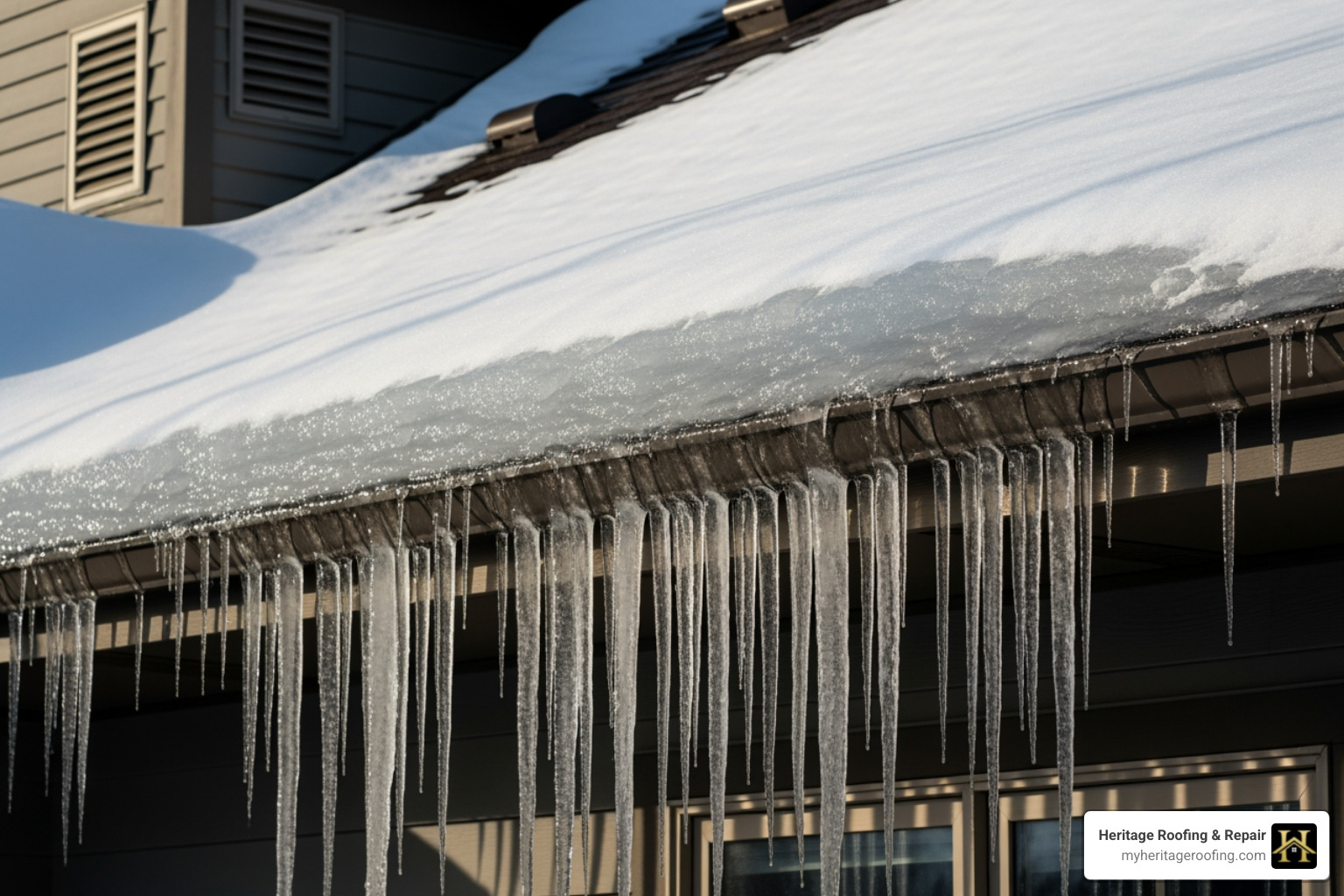
- Ice Dams in Winter: This phenomenon occurs when warm air from your attic melts snow on your roof. The melted water then refreezes at the colder eaves, forming a barrier of ice. This ice dam can cause water to back up under your shingles and leak into your home.
- Attic Condensation & Frost: In colder months, warm, moist air from your living space can rise into the attic. If the attic isn’t properly ventilated, this moisture condenses on cold surfaces like the underside of your roof deck, leading to condensation or even frost.
- Musty Odors: Excess moisture from poor attic ventilation creates an ideal environment for mold and mildew growth, which often manifests as a musty smell emanating from your attic or even into your living spaces.
- Peeling Exterior Paint: While not exclusively an attic ventilation problem, excessive moisture trapped in the attic can sometimes lead to peeling paint on fascia boards or other exterior trim near the roofline, as moisture attempts to escape.
If you’ve noticed any of these signs, it’s time to take action. A professional Roof Inspection Checklist can help identify the root cause.
Visible Damage to Your Roof and Shingles
Your roof shingles bear the brunt of the sun’s harsh rays and temperature extremes. When your attic ventilation fails, this damage accelerates dramatically. Trapped heat in the attic, especially during our hot Northwest Arkansas summers, can cause roof temperatures to soar. This literally “bakes” your shingles from underneath, deteriorating the adhesives in the decking and weakening the wood.
This excessive heat leads to:
- Cracked and Curling Shingles: Shingles become brittle and are prone to cracking and curling.
- Premature Aging and Granule Loss: The protective granules on asphalt shingles are designed to reflect UV rays. Excessive heat causes these granules to loosen and shed prematurely, exposing the asphalt to further degradation. This significantly shortens the lifespan of your roof, leading to premature roof failure.
- Voided Shingle Warranties: Most shingle manufacturers require proper attic ventilation to validate the full terms of their warranty. If your attic is poorly ventilated, you might find that your shingle warranty is voided, leaving you responsible for costly repairs or an early roof replacement.
Don’t let poor ventilation cut your roof’s life short. Understanding these signs is crucial. For repair needs, consult our Shingle Roof Repair Guide 2025.
Moisture, Mold, and Rust in the Attic
The attic should be a dry, healthy space. However, poor ventilation transforms it into a humid, damp environment, creating a breeding ground for problems. Excess moisture from condensation is a primary cause of many attic ventilation issues.
Here’s what to look for:
- Black Stains on Wood: Visible mold and mildew growth on attic insulation, roof decking, or other wood surfaces are undeniable signs of excessive moisture.
- Wet or Compacted Insulation: Moisture droplets from condensation can saturate insulation, reducing its effectiveness (R-value) and causing it to compact. Wet insulation means less insulation, leading to higher energy bills.
- Rusted Nails and Metal Flashing: High humidity accelerates corrosion. You might notice rust on nails protruding through the roof deck, on metal fasteners, or even on HVAC ducts and other metal components in the attic.
- Mildew Smell: Even if you don’t see visible mold, a persistent musty or mildewy smell indicates hidden moisture and microbial growth.
The roof decking itself, often made of wood, holds onto excess moisture, further exacerbating these issues. This excess moisture can compromise your roof decking, leading to sagging and discoloration. For more insights on maintaining a healthy attic environment, refer to A guide to durable attics.
Pest Infestations
It might sound surprising, but poor attic ventilation can even roll out the welcome mat for unwanted guests. The excess moisture and humidity that come with inadequate airflow create an ideal, cozy environment for various pests to thrive.
- Termites and Wood-Boring Insects: These pests are particularly attracted to damp or rotting wood. If condensation or leaks have compromised your roof decking or structural members, it becomes an open invitation for termites to set up shop and cause extensive structural damage.
- Rodents and Other Critters: While not directly attracted by moisture in the same way insects are, rodents are opportunistic. If poor ventilation has led to damaged vents or compromised structural integrity, it creates easy entry points for mice, rats, squirrels, and other animals seeking shelter.
- Entry Points via Damaged Vents: If cracks or problems exist with attic ventsperhaps due to age, improper installation, or storm damagepests will certainly try to take up residence in the attic or home. These vulnerable spots are often overlooked but can lead to significant infestation problems.
Addressing attic ventilation issues isn’t just about protecting your home from the elements; it’s also about keeping it free from pests that can cause further damage and health concerns.
The High Cost of a Suffocating Attic: Unseen Damage and Wasted Money
A poorly ventilated attic doesn’t just feel uncomfortable; it actively costs you money and damages your home. Trapped super-heated air can raise attic temperatures to over 150 F, baking your shingles from below and forcing your AC to work overtime. In winter, trapped moisture leads to a cascade of destructive problems.
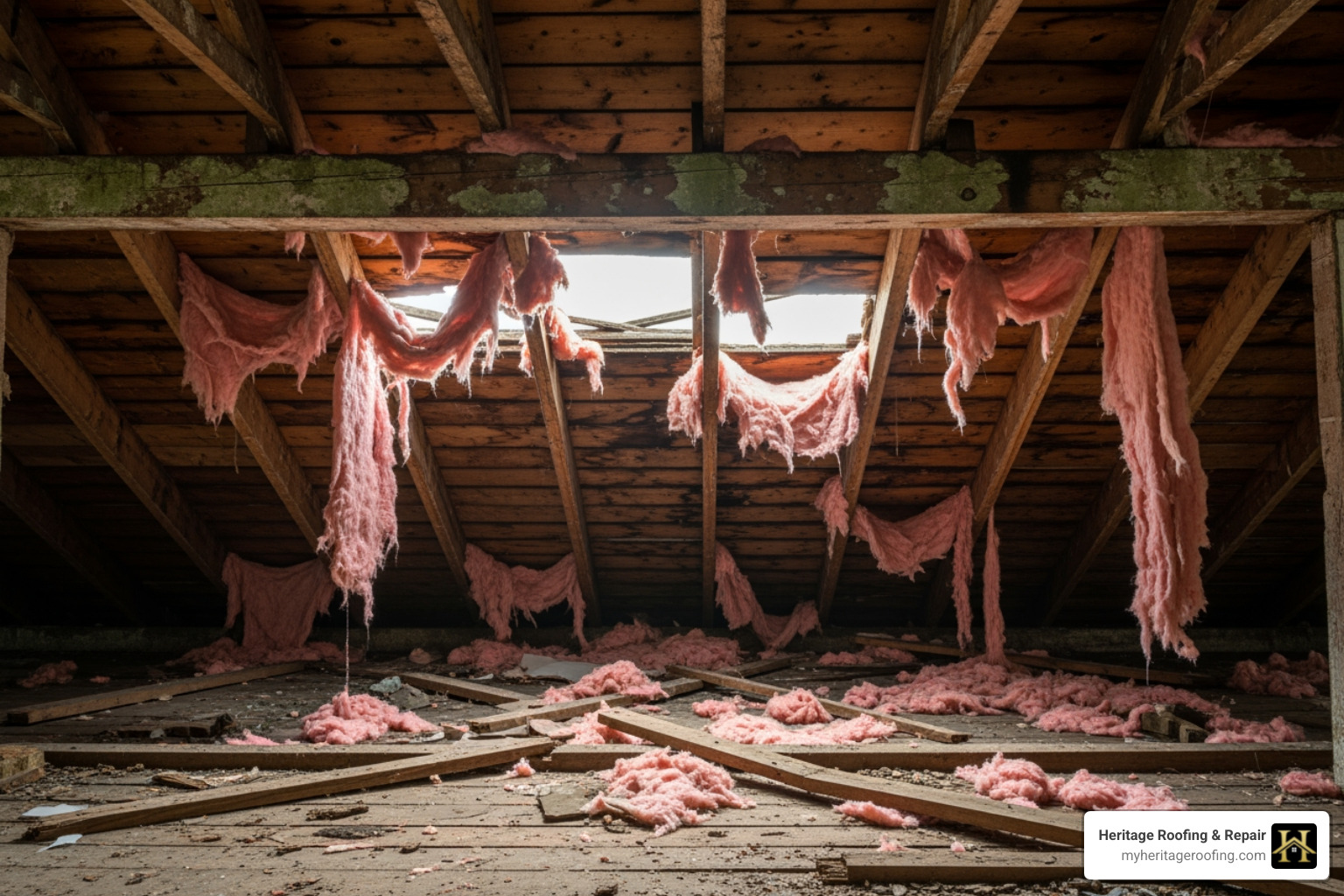
This isn’t an exaggeration; it’s a reality we’ve seen in countless homes throughout Berryville, Harrison, and Fayetteville, AR.
How Poor Ventilation Leads to Increased Energy Bills
Perhaps the most immediately noticeable impact of poor attic ventilation is on your utility bills. Your HVAC system is constantly battling the conditions in your attic, leading to significant energy waste.
- AC Overwork: In summer, without proper ventilation, hot air gets trapped in your attic. This super-heated air radiates down into your living spaces, making them uncomfortably warm. Your air conditioning unit then has to work harder and longer to cool your home, leading to higher energy consumption and increased electricity bills. According to the U.S. Department of Energy, strategies that reduce attic temperatures can lower cooling costs by up to 30%.
- Heat Radiating into Living Space: The temperature difference between a well-ventilated attic and a poorly ventilated one can be substantial. An attic that’s 150 F will transfer far more heat into your home than one that’s closer to the outside ambient temperature.
- Reduced Insulation Effectiveness (R-value): When moisture builds up in the attic due to poor ventilation, it can saturate insulation. Wet or damp insulation loses its R-value (its ability to resist heat flow), making it less effective at keeping your home cool in summer and warm in winter. This means your home is less energy-efficient year-round.
- Increased Heating Costs in Winter: Just as heat radiates down in summer, it escapes up in winter. Inadequate attic insulation, often exacerbated by moisture from poor ventilation, allows heat to escape in colder months, undermining attic durability and increasing home heating bills.
Investing in proper attic ventilation is a direct investment in your home’s energy efficiency. A well-ventilated attic helps maintain a more stable home temperature, reducing the strain on your HVAC system and leading to significant savings.
The Destructive Cycle of Ice Damming
For homes in Northwest Arkansas, winter brings the beautiful sight of snow, but also the potential for destructive ice dams if your attic isn’t properly ventilated. This isn’t just an aesthetic problem; it’s a serious threat to your home’s integrity.
- Heat Escape: The cycle begins when heat from your living space escapes into the attic. This can be due to poor insulation, air leaks, or simply the natural warmth of your home.
- Snow Melting on Roof: This escaping heat warms the roof deck, causing snow on the upper parts of the roof to melt.
- Water Refreezing at Eaves: As this melted water flows down the roof, it reaches the colder eaves and gutters, which extend beyond the heated portion of the house. Here, the water refreezes, forming a barrier of icethe notorious ice dam.
- Water Backup Under Shingles: Once an ice dam forms, it prevents subsequent melted snow from draining off the roof. The water backs up behind the ice, creating a pool that can seep under your shingles, through the roof deck, and into your attic and home. This can cause significant water damage to ceilings, walls, and insulation.
- Gutter Damage: The sheer weight of ice dams can pull gutters away from your house, cause them to bend, or even tear them off completely.
Proper attic ventilation helps even out roofing temperatures to avoid damage from this thawing and freezing cycle. It works by keeping the entire roof deck cold, preventing the initial melting that leads to ice dams. Dealing with ice dam damage can be costly, so prevention is key. Learn more about potential expenses in our Roof Repair Cost guide.
Structural Damage from Condensation and Rot
The silent killer in an unventilated attic is moisture. Condensation, which we discussed earlier, doesn’t just make things damp; it actively breaks down the very structure of your home.
- Moisture Absorption in Wood: Wood-based roof decking and structural framing are highly susceptible to moisture absorption. When constantly exposed to high humidity and condensation, these materials soak up water like a sponge.
- Roof Deck Sagging and Warped Sheathing: Excess moisture compromises the wood roof decking, making it wavy, discolored, and ultimately leading to sagging. This can manifest as visible undulations on your roof’s exterior. Warped sheathing can also affect the integrity and appearance of your roof.
- Weakened Structural Framing: Over time, continuous moisture exposure leads to wood rot in rafters, trusses, and other structural members. This rot weakens the framing, compromising the structural integrity of your entire roof and potentially the house itself.
- Reduced Nail-Holding Capacity: When wood becomes damp and then dries repeatedly, it expands and contracts. This movement causes nails to loosen, reducing the roof’s ability to hold shingles securely. In severe cases, this can lead to shingles sliding off or the roof deck losing its ability to support its load.
In the humid and damp conditions common in Northwest Arkansas, proper attic ventilation is crucial to prevent these severe forms of water damage, rotting wood, mold, mildew, and structural damage to framing. Don’t let moisture compromise your home’s foundation. If you suspect a leak, our Roof Leak Detection services can help.
Local Expert Resource: Heritage Roofing & Repair
For homeowners who want field-tested attic ventilation solutions in the Ozarks, Heritage Roofing & Repair maintains a dedicated service hub in Berryville:
Heritage Roofing & Repair
3458 Arkansas State Hwy 221, Berryville, AR 72616
Phone: (870) 654-1164
Our crews document every attic ventilation inspection, tracking attic temperature, relative humidity, vent type, and shingle condition. This internal dataset allows us to benchmark how different vent configurations perform in real Northwest Arkansas weather, and to recommend upgrades that are backed by observed performance rather than theory.
The Science of Airflow: Proven Fixes for Attic Ventilation Issues
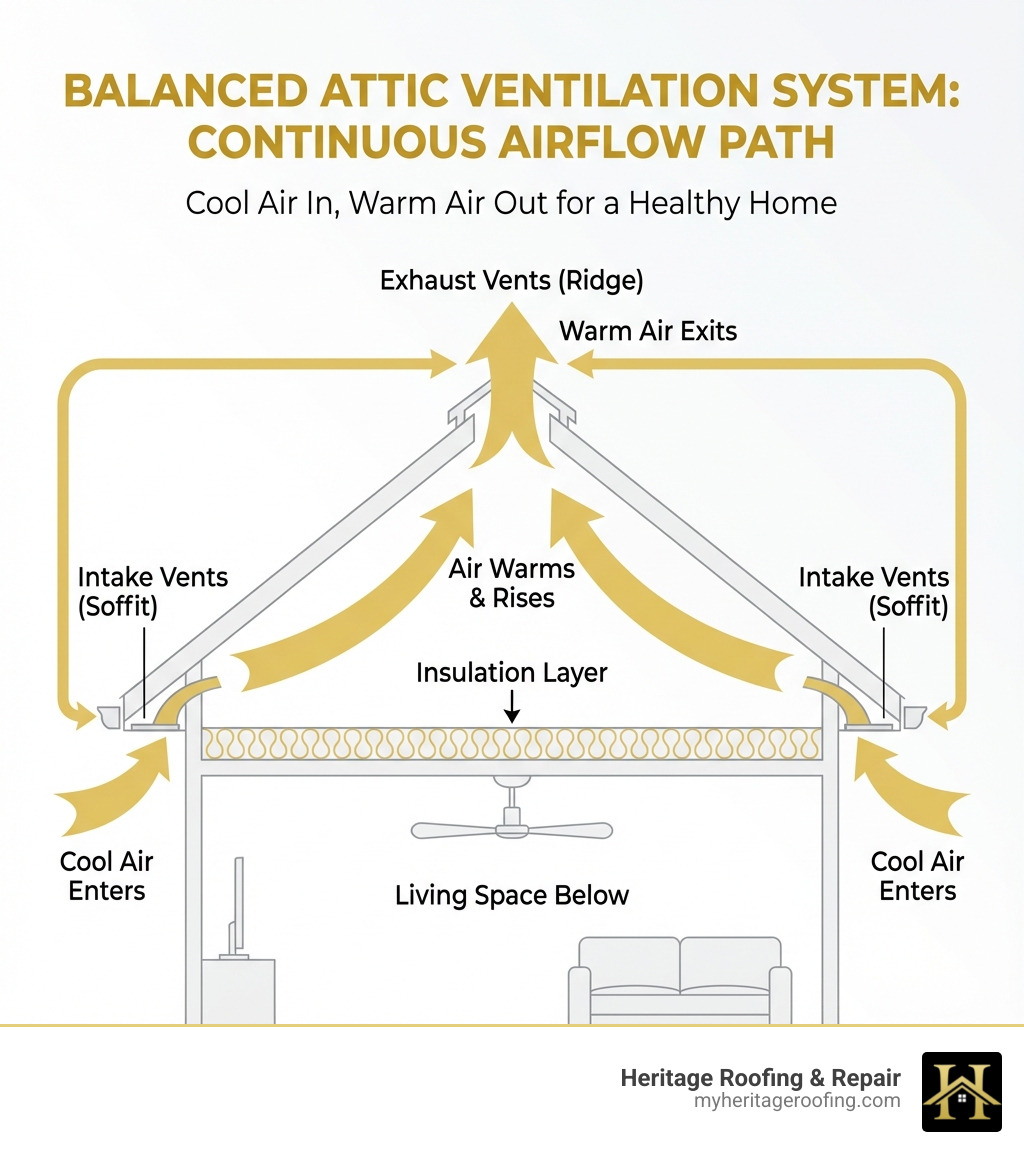
The solution to most attic ventilation issues lies in creating a balanced system where the amount of intake airflow matches the amount of exhaust airflow. This continuous, passive movement of air is the key to regulating temperature and humidity year-round. Think of it as your attic’s natural breathing system.
Why Balanced Intake and Exhaust is Non-Negotiable
Effective attic ventilation relies on the principles of natural convection and the “stack effect.” Warm air naturally rises, and a well-designed ventilation system harnesses this to continuously draw in cool, fresh air and expel hot, moist air.
- Stack Effect: Warm air inside the attic is less dense than cooler outside air. This difference in density creates a pressure differential, causing the warmer, lighter air to rise and exit through exhaust vents at the highest point of the roof. As this warm air leaves, it creates a slight vacuum, pulling in cooler, denser air through intake vents located at the lower parts of the roof (eaves or soffits).
- Convection: This continuous movement of air, driven by temperature and pressure differences, is known as convection. It’s how your attic “breathes,” preventing heat and moisture from stagnating.
- The 1:300 Rule (Net Free Area – NFA): A widely accepted guideline for adequate attic ventilation is the 1:300 rule. This means you need 1 square foot of Net Free Vent Area (NFA) for every 300 square feet of attic floor space. The NFA refers to the total unobstructed opening through which air can pass. This area should be split equally between intake and exhaust. For example, if your attic floor is 1,500 sq ft, you’d need 5 sq ft of NFA total (2.5 sq ft intake, 2.5 sq ft exhaust).
- Preventing Negative Pressure: Balanced ventilation is crucial. If you have significantly more exhaust than intake, or vice-versa, you create an unbalanced system. Too much exhaust can lead to negative pressure in the attic, potentially pulling conditioned air from your living space through ceiling penetrations into the attic, which wastes energy.
As recognized by the building science community, understanding attic ventilation is critical for home durability and energy efficiency. For a deeper dive into the science, refer to Understanding Attic Ventilation, BSD-102.
Your Ventilation Toolkit: A Guide to Different Vent Types
Choosing the right combination of vents is key to achieving balanced airflow. The most effective systems pair intake vents low on the roof with exhaust vents high on the roof. Heres a breakdown of common vent types:
A Homeowner’s Guide to Roof Vent Types
| Vent Type | Function (Intake/Exhaust) | Pros | Cons | Best Use Case |
|---|---|---|---|---|
| Soffit Vents | Intake | – Visually unobtrusive – Provides continuous airflow – Protects against weather and pests |
– Can be blocked by insulation or paint – Not suitable for all roof designs (e.g., no overhangs) |
The foundation of most balanced ventilation systems, installed in the eaves. |
| Gable Vents | Intake / Exhaust | – Easy to install on gable walls – Can provide significant airflow |
– Can “short-circuit” a soffit-to-ridge system – Ineffective without wind – Can allow rain/snow entry |
Older homes without soffits, or as a supplementary (not primary) vent in specific designs. |
| Ridge Vents | Exhaust | – Most effective and efficient exhaust method – Provides even ventilation along the entire roof peak – Low profile aesthetic |
– Requires precise installation – Higher initial cost than box vents – Must be paired with adequate soffit intake |
The gold standard for exhaust ventilation on most pitched roofs. |
| Box Vents (Static Vents) | Exhaust | – Inexpensive and simple – No moving parts to fail |
– Less effective than ridge or turbine vents – Requires multiple vents for proper coverage – Can be blocked by heavy snow |
A budget-friendly option for smaller roofs or as a supplement to other exhaust vents. |
| Turbine Vents | Exhaust | – Actively pulls air out using wind power – More effective than static vents |
– Moving parts can wear out and become noisy – Ineffective on calm days – Can be damaged in high winds |
Homes in consistently windy areas that need an active pull to remove hot air. |
| Powered Attic Ventilators (PAVs) | Exhaust | – Moves large volumes of air quickly – Thermostat/humidistat controls for automation |
– Uses electricity, increasing utility costs – Can create negative pressure, pulling conditioned air from the home – Can be noisy |
Situations with extreme heat buildup where passive systems are insufficient, but requires a perfectly sealed attic floor. |
| Solar-Powered Vents | Exhaust | – Same benefits as PAVs but uses no grid electricity – Eco-friendly |
– Higher initial cost – Only operates in direct sunlight – Carries the same negative pressure risk as PAVs |
A green alternative to electric PAVs for sunny climates, with the same caveats about needing a sealed attic. |