What You Need to Know About Single-Ply Roofing
Single-ply roofing is a wide-sheet synthetic membrane designed for low-slope commercial roofs, offering a lightweight, durable waterproofing solution that has become the industry standard. For commercial property owners in Northwest Arkansas, understanding these modern systems is key to making a sound investment in their building’s future. Heritage Roofing & Repair has provided expert commercial roofing services for over 50 years, helping businesses select the ideal membrane for their needs.
Key Facts:
- Material: Synthetic polymer sheets (TPO, PVC, or EPDM)
- Installation: Single-layer application
- Cost: $3.50-$7.50 per square foot installed
- Lifespan: 10-50 years depending on material
- Weight: Significantly lighter than traditional built-up roofing
- Seams: Heat-welded (TPO/PVC) or taped (EPDM)
- Benefits: Faster installation, UV resistance, energy efficiency, lower labor costs
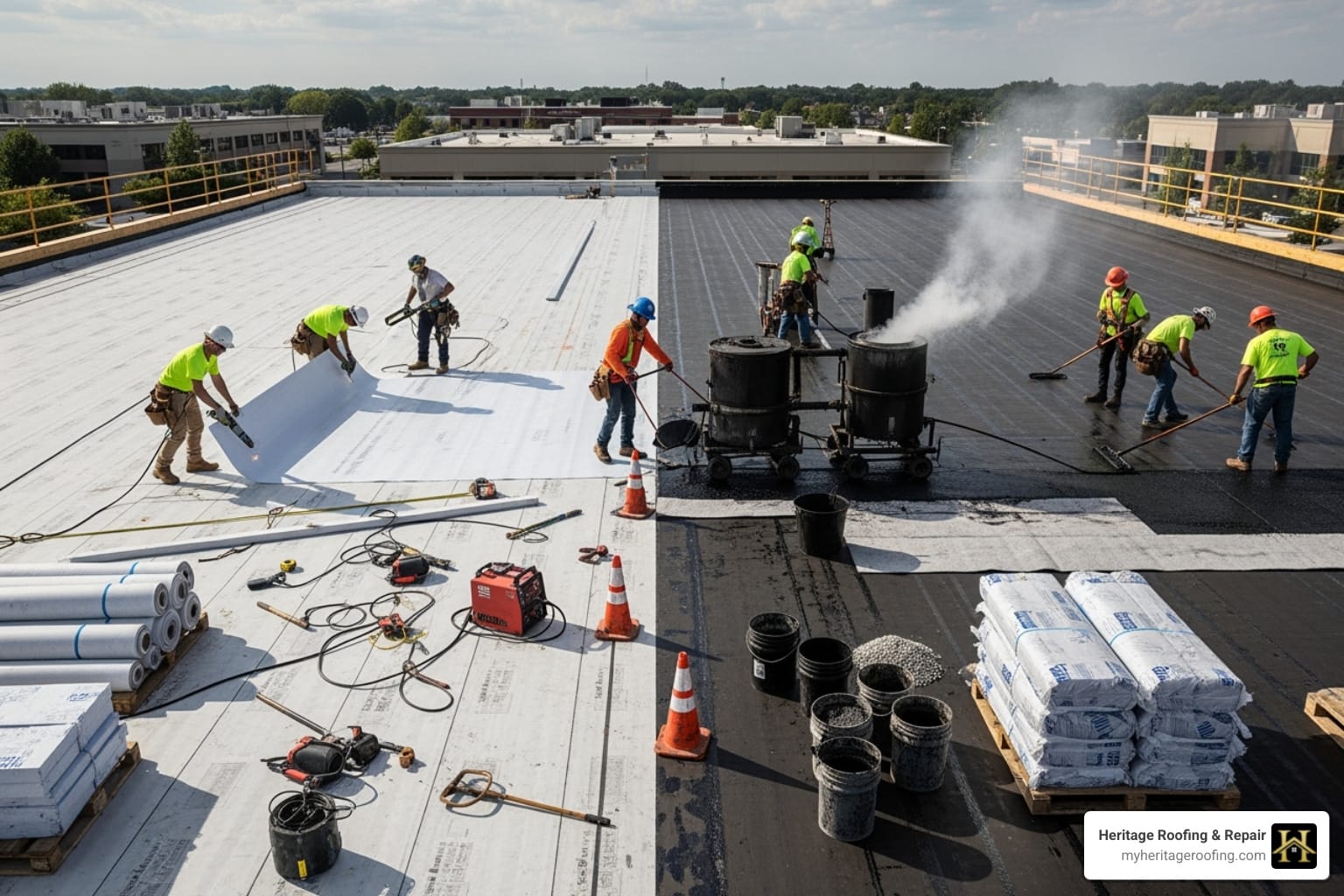
Single-ply systems have revolutionized the roofing industry by consolidating the waterproofing of older, multi-layered roofs into one factory-produced membrane. This innovation allows for installation in a fraction of the time—on average, 54.2 labor minutes per square compared to 156.5 minutes for traditional mopped covers. These systems dominate the market because they deliver superior performance with less structural stress, reduced installation time, and excellent resistance to UV rays and extreme weather.
With over 50 years of family experience, we’ve installed and maintained countless single-ply roofing systems. Whether you’re evaluating TPO for energy efficiency, PVC for chemical resistance, or EPDM for long-term durability, this guide breaks down everything you need to make an informed decision.
Glossary for single ply roofing:
What is Single-Ply Roofing and Why is it the Industry Standard?
Single-ply roofing is a flexible sheet of synthetic polymer material, manufactured to precise factory specifications, that is rolled out and secured to a roof deck in a single, continuous layer. This approach is a complete waterproofing solution engineered before it ever reaches your building.
Unlike traditional systems that required building up multiple layers on-site with hot asphalt, single-ply membranes arrive ready to install. This innovation has made them the undisputed standard in commercial roofing. The defining features include a single-layer membrane made from advanced polymers like TPO, PVC, or EPDM. These materials are lightweight, flexible, and UV-resistant. Crucially, they create wider sheets and fewer seams than asphaltic systems, minimizing potential leak points. For a deeper technical dive, this guide to single-ply systems offers excellent details.
The Modern Advantage Over Traditional Roofing
For much of the 20th century, commercial roofs were protected by heavy Built-Up Roofing (BUR)—”tar and gravel” systems involving layers of hot asphalt and reinforcing fabric. The process was slow, labor-intensive, and produced hazardous fumes. Modified Bitumen later improved flexibility but still required multiple layers and complex installation.
Single-ply roofing consolidates all that protection into one robust sheet. The time savings are dramatic: single-ply systems can be installed 2.89 times faster than traditional mopped roofs, requiring just 54.2 labor minutes per square compared to 156.5 minutes. For business owners, this means lower labor costs, minimal disruption, and a cleaner, safer installation process. Our guide on Built Up Roofing Installation details these older, labor-intensive methods.
Key Characteristics and Benefits
- Waterproof Integrity: Continuous sheets with heat-welded or taped seams create an exceptional barrier against water intrusion.
- Fire Safety: Many single-ply systems achieve a Class A fire rating, the highest level available, which can positively impact insurance premiums.
- Energy Efficiency: Light-colored membranes like white TPO and PVC create a “cool roof” effect, reflecting sunlight to lower cooling costs, especially in hot Arkansas summers.
- Durability: Engineered membranes resist UV degradation, extreme temperature swings, and hail damage, ensuring they last for decades.
- Lightweight: A single-ply membrane weighs significantly less than a built-up roof, placing minimal stress on a building’s structure and potentially avoiding the need for costly reinforcement.
- Flexibility: The membranes accommodate a building’s natural expansion and contraction without cracking or failing.
- Low Maintenance: Regular inspections and basic cleaning are all that’s needed to keep these systems performing for decades.
The Three Titans: A Deep Dive into TPO, PVC, and EPDM Membranes
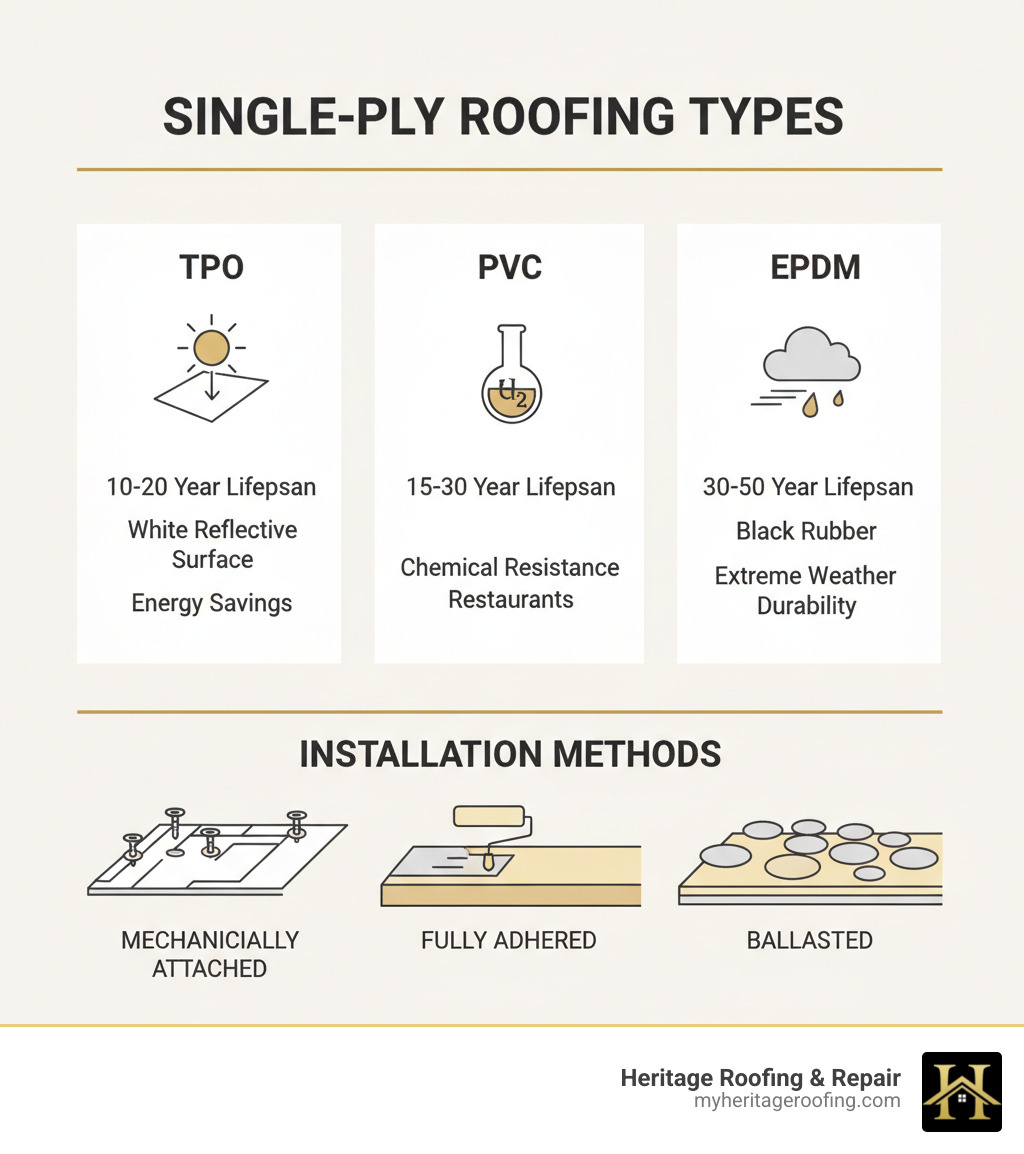
When evaluating single ply roofing, you’ll encounter three primary materials: Thermoplastic Polyolefin (TPO), Polyvinyl Chloride (PVC), and Ethylene Propylene Diene Monomer (EPDM). Choosing the right one is about matching the material’s strengths to your building’s specific needs, climate, and budget.
![TABLE] comparing TPO, PVC, and EPDM on Lifespan, Seam Strength, Key Advantage, and Ideal Use Case. – single ply roofing](https://images.bannerbear.com/direct/4mGpW3zwpg0ZK0AxQw/requests/000/110/578/132/jMDOvP3KezR5oVl4Ylqoyk8AW/8288cbd874a7b85a21efd887792607c3e584f050.jpg)
The core difference is chemical. Thermoplastic membranes (TPO and PVC) can be heat-welded to form a monolithic bond stronger than the membrane itself. Thermoset membranes like EPDM are cured into a permanent state and cannot be re-melted; their seams are joined with specialized adhesive tapes. This distinction impacts installation, repairs, and overall seam strength.
TPO (Thermoplastic Polyolefin): The Popular & Reflective Choice
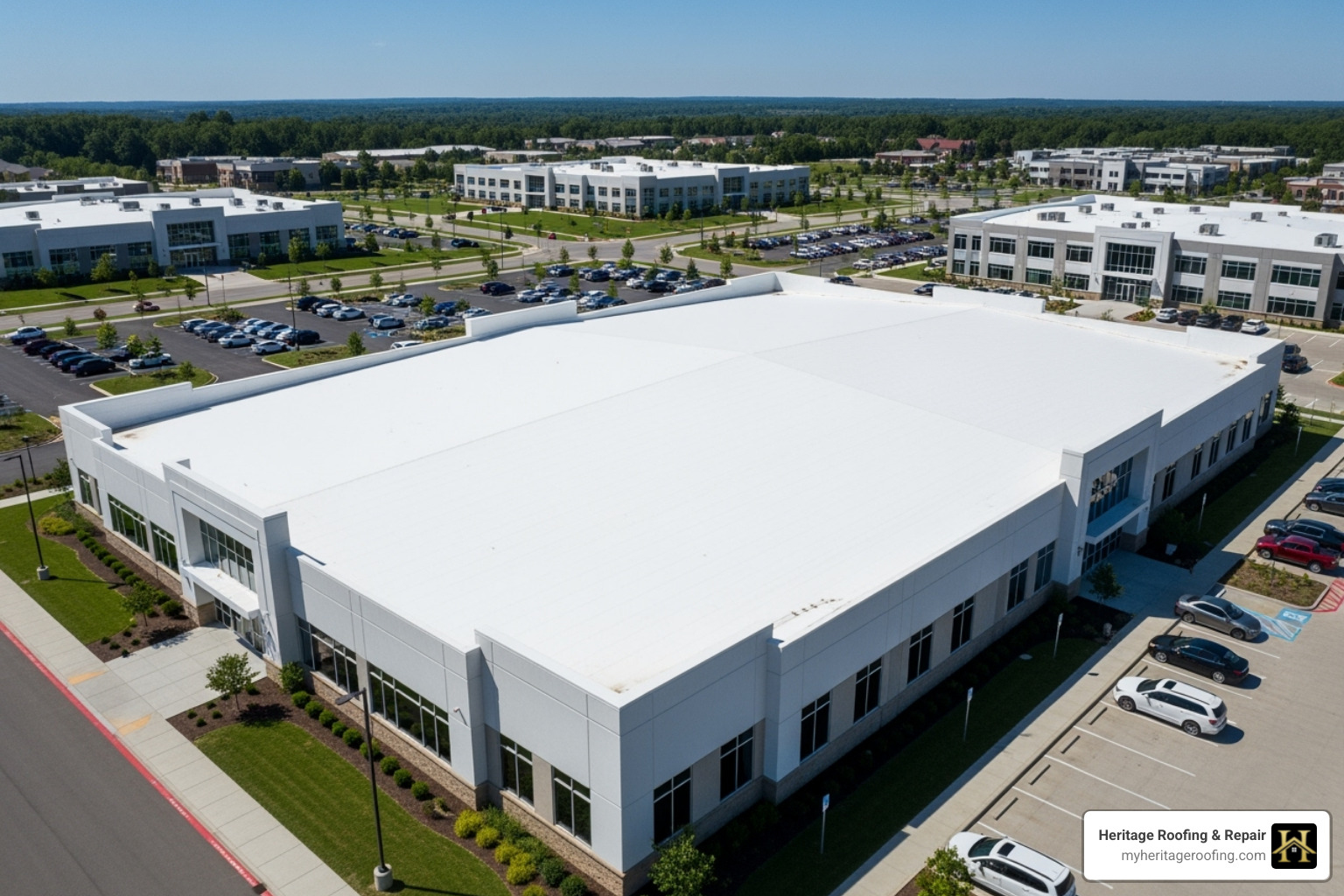
Thermoplastic Polyolefin (TPO) is the most widely installed commercial roofing product in North America. Its standout feature is a bright white, highly reflective surface that creates a “cool roof,” capable of reducing a building’s cooling costs by 20-30%.
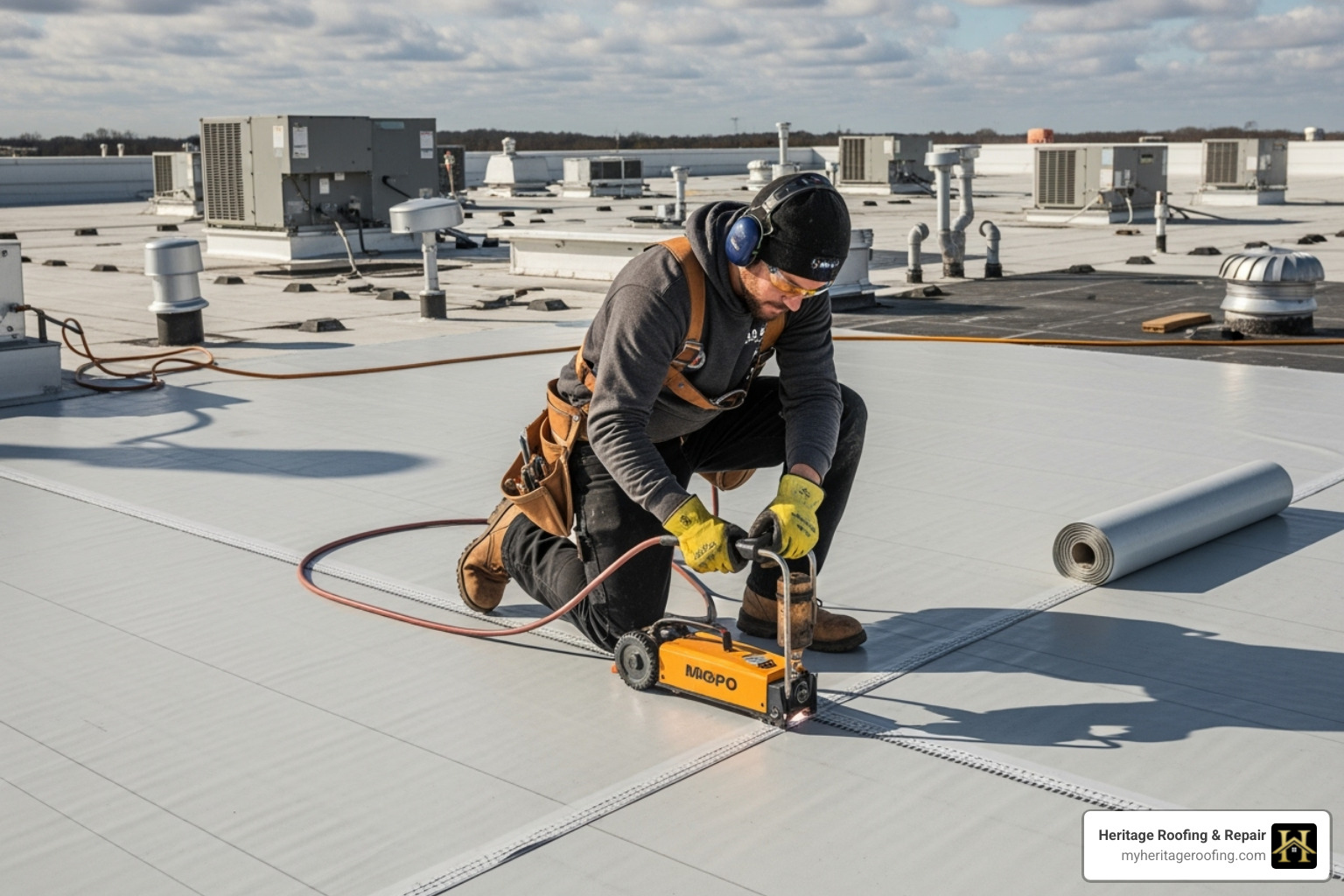
TPO’s seams are heat-welded with hot air, creating a watertight roof that resists wind uplift. The material also offers good puncture resistance and stands up well to UV exposure. With a typical lifespan of 10-20 years, TPO provides solid performance at a competitive price, making it a versatile choice for most commercial buildings. For more details, explore our in-depth guide to TPO Roof Construction.
PVC (Polyvinyl Chloride): The Durable & Chemical-Resistant Veteran
With over 50 years of proven performance, Polyvinyl Chloride (PVC) roofing is a seasoned veteran. Its key advantage is exceptional resistance to chemicals, grease, fats, and oils. This makes PVC the smartest choice for restaurants, food processing facilities, and industrial plants where roof exposure to these substances is a concern.
Like TPO, PVC features strong, heat-welded seams and is inherently fire-resistant. It maintains flexibility in cold weather while providing high tensile strength. PVC roofing systems typically last 15-30 years, often outperforming TPO in demanding environments, though it usually comes with a higher initial material cost.
EPDM (Ethylene Propylene Diene Monomer): The Resilient & Long-Lasting Rubber
EPDM is a synthetic rubber membrane with a track record of durability stretching back over 60 years. Its defining characteristic is exceptional flexibility across extreme temperature ranges, making it remarkably resilient against hail and severe freeze-thaw cycles. The rubber expands and contracts with the building, preventing cracks.
EPDM is typically black, which helps melt snow in colder climates, though white options are available. Its seams are joined using adhesive tapes, not heat welding. With a lifespan of 30-50 years, EPDM offers one of the longest service lives of any commercial roofing material. It excels in regions with severe weather fluctuations where its proven longevity provides the best long-term value. For a complete overview, see our EPDM Installation Guide.
Installation Systems for Single-Ply Roofing: How It’s Done
Single-ply roofing offers flexible installation methods that can be adapted to a building’s structure, climate, and budget. Unlike older methods, the process is faster, cleaner, and safer, with no hot asphalt or hazardous fumes. The chosen assembly directly impacts wind uplift resistance, installation speed, and cost.
For a deeper understanding of how these systems integrate with other components, you can explore our guide on flat roof systems. The external resource What is Single-Ply? also provides valuable insights.
Mechanically Attached Systems
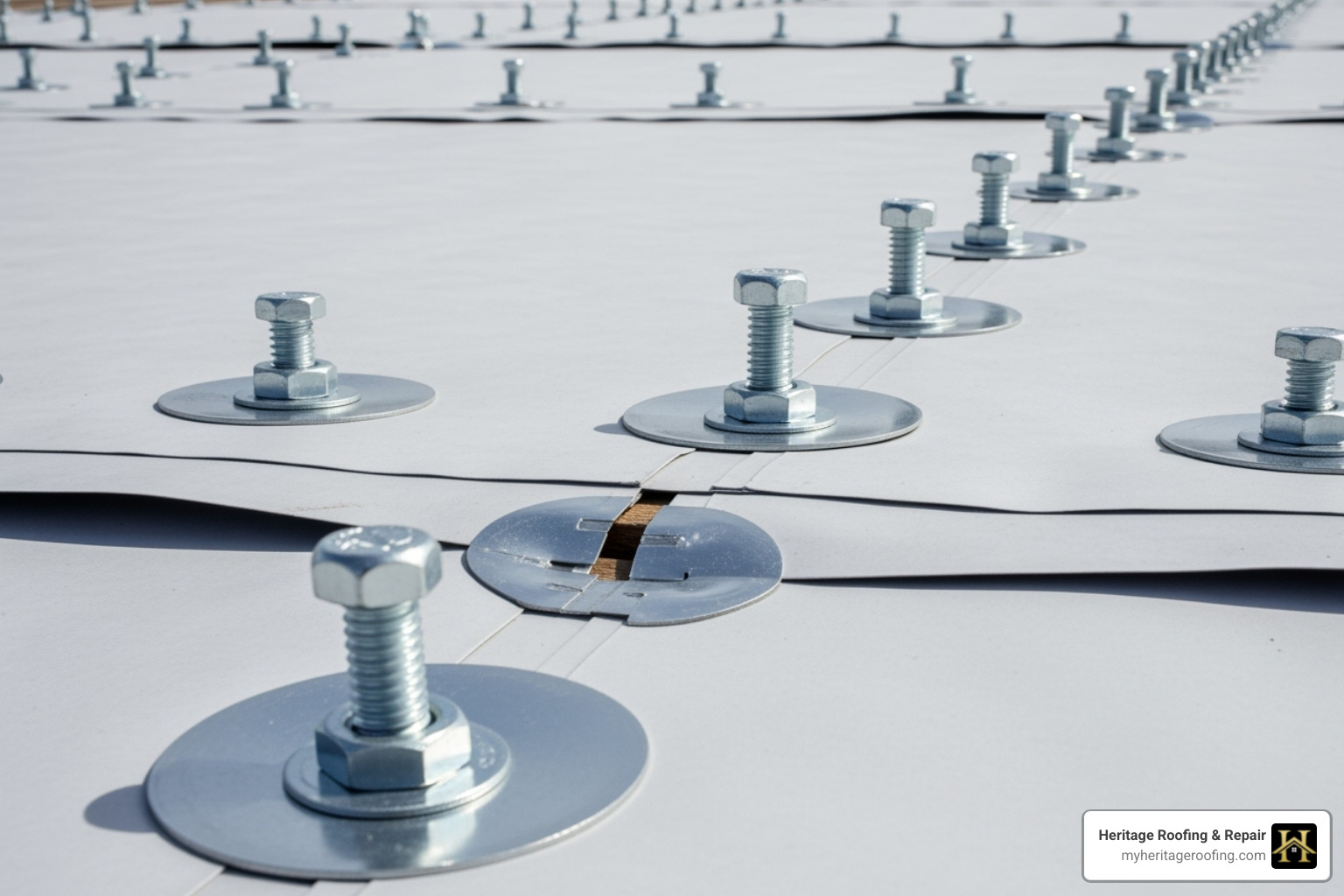
This is the most common installation method, striking a balance between performance and cost-effectiveness. The membrane is rolled out and secured with specialized screws and plates anchored to the structural deck. Subsequent rolls overlap the fasteners, and seams are welded or taped to create a continuous, watertight surface. This lightweight method is suitable for nearly any building, offers excellent wind uplift resistance, and its quick installation reduces labor costs. Proper sealing of all penetrations is critical for long-term performance.
Fully Adhered Systems
For the smoothest aesthetic and superior strength, fully adhered systems are an excellent choice. A bonding adhesive is applied to the substrate, and the membrane is rolled into it, creating a monolithic system with no deck penetrations. This method provides outstanding wind uplift resistance and is ideal for roofs with complex shapes or high visibility. The trade-offs are higher material and labor costs and sensitivity to weather conditions during installation, as adhesives require specific temperatures to cure properly.
Ballasted Systems
This economical approach is ideal for large, simple roofs on buildings with sufficient structural strength. The membrane is laid loosely over the insulation and held in place by a layer of ballast, such as smooth river rock or concrete pavers. This method is fast and cost-effective, as it eliminates the need for fasteners or adhesives. The ballast also protects the membrane from UV rays and foot traffic. However, the building must be engineered to support the significant added weight (10-15 lbs/sq. ft. or more).
If you’re located in the Berryville area and would like us to evaluate which installation system best suits your commercial property, our team at Heritage Roofing & Repair can help. We have installed all three systems countless times and know how to match the right approach to your building’s needs.
Heritage Roofing & Repair
3458 Arkansas State Hwy 221, Berryville, AR 72616
(870) 654-1164
Cost, Longevity, and ROI: The Financials of Single-Ply Roofing
When considering a commercial roof replacement, the financial picture is as important as the technical one. Single-ply roofing offers one of the strongest returns on investment available, balancing upfront costs with long-term savings.
Understanding the Costs of a Single-Ply Roofing System
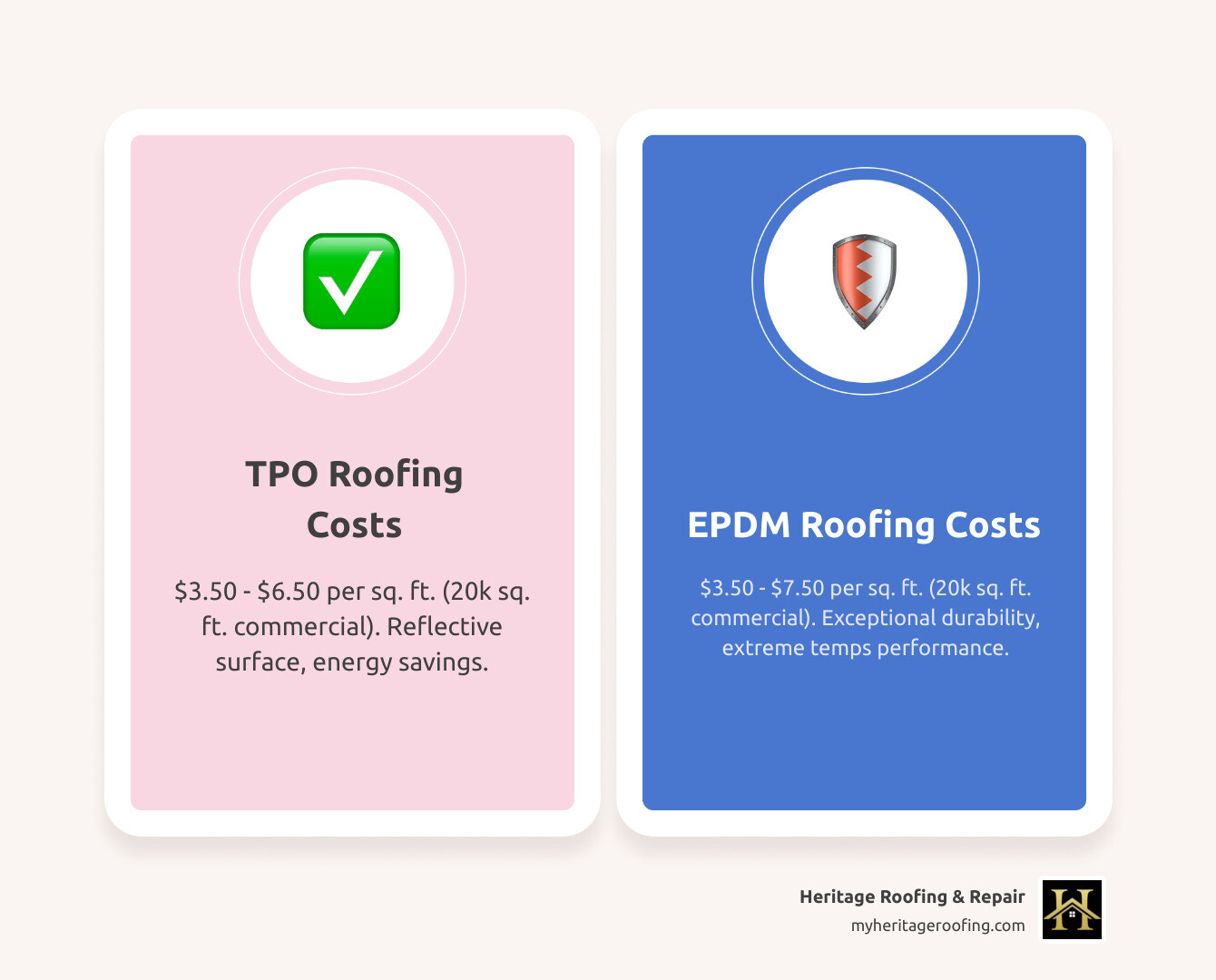
For a typical commercial roof, expect an average investment of $3.50 to $7.50 per square foot for a complete single-ply roofing system, including materials, installation, and warranty. Several factors influence this range:
- Membrane Type & Thickness: A thicker membrane (e.g., 80-mil vs. 45-mil) costs more but offers better durability and a longer warranty. PVC is typically more expensive than TPO.
- Installation Method: Mechanically attached systems are generally the most economical, while fully adhered systems cost more due to adhesives and labor.
- Insulation Choice: Higher R-value insulation costs more upfront but delivers greater long-term energy savings.
- Project Complexity: A simple, rectangular roof costs less per square foot than one with numerous HVAC units, skylights, and other penetrations.
- Tear-Off vs. Overlay: Installing over an existing roof can save on tear-off costs, but a full tear-off is necessary for damaged or multi-layered roofs.
A slightly higher initial investment in a thicker membrane or better insulation often pays for itself through energy savings and reduced maintenance. For a broader comparison, see our roofing materials overview or explore our roofing financing options.
Maximizing Lifespan with Proper Maintenance
Consistent care is the key to maximizing the lifespan of a single-ply roof. A well-maintained EPDM roof can last up to 50 years, while TPO and PVC systems can deliver 10-20 and 15-30 years of service, respectively. Key practices include:
- Biannual Inspections: Catching small punctures or loose seams in spring and fall prevents them from becoming major, costly problems.
- Debris Removal: Clearing leaves, branches, and dirt prevents moisture from being trapped against the membrane and keeps drains from clogging.
- Seam and Flashing Checks: These high-stress areas are the most common source of leaks and require regular attention.
- Prompt Repairs: Immediately addressing minor damage prevents water infiltration that can compromise insulation and the roof deck.
Our proactive roof maintenance plans are designed to help you achieve the maximum lifespan for your roofing system.
Warranties and Return on Investment
Manufacturer warranties for single-ply roofing typically range from 15 to 35 years, with longer terms offered for thicker membranes and more robust installation systems. Understanding your roofing warranty is crucial. The return on investment (ROI) comes from three main sources:
- Lower Energy Bills: Reflective “cool roofs” can reduce cooling costs by 20-30%.
- Reduced Maintenance Costs: These streamlined systems require less intervention than older multi-layer roofs.
- Long Service Life: A durable roof that lasts for decades avoids the expense and disruption of frequent replacements.
Making the Right Choice for Your Northwest Arkansas Property
Selecting the right single ply roofing system requires matching the membrane and installation method to your property’s unique needs and our local climate. The varied weather in Northwest Arkansas—from intense summer heat and UV rays to hailstorms and freezing winters—demands a thoughtful approach.
- For Hot Summers: A highly reflective white TPO or PVC membrane deflects sunlight, keeping your building cooler and reducing HVAC strain.
- For Hail and Freeze-Thaw Cycles: EPDM’s superior flexibility allows it to expand and contract without cracking and provides legendary resilience against hail impacts.
- For Restaurants or Industrial Use: If your roof is exposed to grease, oils, or chemicals, PVC’s exceptional chemical resistance is essential protection.
- For High Foot Traffic: A thicker membrane (e.g., 80-mil) or designated walkway pads provide extra durability for roofs with frequent maintenance access.
- For High Winds or Complex Shapes: Fully adhered or mechanically attached systems offer superior wind uplift resistance. A lightweight system is critical for buildings with limited load-bearing capacity.
Choosing the right system is crucial for optimal performance. At Heritage Roofing & Repair, we’ve helped Northwest Arkansas business owners steer these decisions for over 50 years. We understand how different materials perform in our specific climate and partner with you to select a system that protects your investment for decades.
Conclusion: Securing Your Commercial Investment with the Right Roof
Choosing the right single-ply roofing system is about more than just keeping water out; it’s a strategic investment in your commercial property’s future. It’s a high-performance solution that delivers returns through energy savings, low maintenance, and decades of reliable service.
The evolution from heavy, hazardous tar-and-gravel systems to lightweight, engineered membranes represents a major leap forward. Modern single-ply roofing is cleaner to install, offers superior energy efficiency, and provides lifespans of up to 50 years, meaning you make a decision that protects your building for the long haul.
The journey through TPO’s efficiency, PVC’s chemical resistance, and EPDM’s durability shows there is a custom solution for every need. Whether you’re concerned about energy costs, chemical exposure, or our challenging Northwest Arkansas weather, there is a membrane and installation method that fits perfectly.
At Heritage Roofing & Repair, our 50 years of experience are built on dependable, affordable, and quality craftsmanship. We don’t just install roofs—we build lasting relationships by helping you select the system that offers the best protection and return on your investment.
Ready to explore the best roofing options for your business? Learn more about our expert commercial roofing services and let’s discuss which system is right for your property.